Podcast
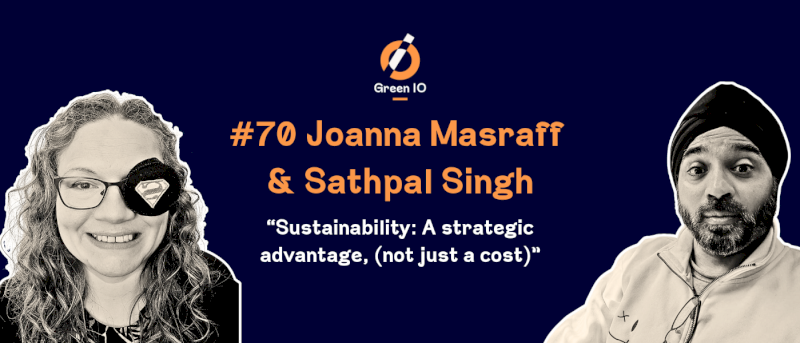
Episode 70 - Sustainability: A Strategic Advantage, (Not Just a Cost), with Sathpal Singh and Jo Masraff
Transcript
Sathpal Singh:
Organizations collect huge volumes of data, but if they are not using the data and drawing meaningful insights from the data, there's no value or benefit to gained. Think about what's the next most valuable thing you as an organization could do, starting where you are now. And being dedicated and committed to it. Again, these are Agile values, right, will see you make some incremental improvements.
Gaël Duez:
Hello everyone. Welcome to Green IO. I'm Gaël Duez, and in this podcast, we empower responsible technologists to build a greener digital world, one byte at a time. Twice a month, on a Tuesday, our guests from across the globe share insights, tools and alternative approaches, enabling people within the tech sector and beyond to boost digital sustainability.
If the choices made during the design phase of a digital product influence its environmental footprint up to 80% as the green IT expert, Frederic Bordage likes to say, how could we turn every product person into a green product person? And what are the main hurdles preventing product practitioners from embedding sustainable practices in their day-to-day operations?
How could sustainability be viewed as a success factor, not a cost. Our two guests today conducted a small qualitative study with product managers and product owners a few months ago, and they got interesting insights, which resonated with a huge experience in sustainability, agility, and green software.
One is a pirate and the other a smuggler. Jo Masraff, AKA pirate Jo is a connector of patterns and people who's never shy of daring. She's the co-organizer of the Agileists for Planet and Agileists for Sustainability meetups and an international speaker and thought leader in Agile and sustainability. Sathpal Singh maneuvers his boat among many fields at the intersection of software, digital product development, Agile practices, and community building. He's also chair of BCS Agile Methods Group, the organizer of Future of Work Scotland Meetup, and an international keynote speaker and professional Kanban trainer. And both are co-founders of Green PO. I wanted to talk a bit more about product management and design from a sustainability perspective for several months, and Jo and Sath are the perfect guests for this. So welcome Jo and Sath. Thanks a lot for joining Green IO today.
Jo Masraff:
Thanks for having us, Gaël.
Sathpal Singh:
Absolutely great to be here.
Gaël Duez:
Yeah, I'm happy that you will get some little sunshine somewhere in your island, in a gloom and, and, and dark and, and cold day in Scotland.
Sathpal Singh:
That's the way we like it. We've got, we've got good at it.
Gaël Duez:
But anyway, so thanks a lot for joining and I think that one of the main focuses of our discussion is about this study that you conducted to get more insights on these hurdles and, and why this low rate of adoption of green practices or sustainable practices, you will maybe explain the difference. So maybe Jo, could you tell us more about how it was conducted and what the main findings were?
Jo Masraff:
Yeah, absolutely. So Green PO partnered with a bunch of other agencies across Europe to conduct the studies. So we have ThoughtWorks, we have Improuv, DigitalNatives and The Garage. We've combined together to do this survey and the main findings are exactly, you know, one of them is exactly like you're saying, the adoption rate of sustainable practices is still low. What we've found out is interesting, one of the interesting things is we asked people to rate themselves on their understanding and know-how of sustainable practices, and they still, still, we still have an average of 4.4 on the knowledge scale. Actually, what we didn't tell them, what sustainability was, so throughout the interviews, we started to understand actually, you know, what their know-how and knowledge was and of course, as per usual, we tend to rate ourselves a little bit higher maybe than, than is the actual truth, right, when it comes to knowledge. So that, that knowledge piece, that underlying, you know, foundational stone of how people can take action was missing. So the understanding of sustainability was low. We talked about, for example, you know, we love an iceberg model in, in Agile, in IT, right? Sustainability iceberg for us is, is seeing that, you know, on the top it's very much that regulatory piece and in regulation in IT specifically, there's very little in sustainability, unless you look at the social sustainability side. So accessibility and inclusion are the big ones when it comes to, to what's being adopted. What's kind of sometimes depressing for me actually is that people still need a lot of help to make their digital services accessible.
It's still not the done thing to make sure that your service is accessible right. People are still working towards that, and we found that almost 30% of our interviewees, that's where they're at. They're thinking about social regulatory sustainability and that's where their focus is, and they think they're being super sustainable by doing that. Of course, it's super important, but it wasn't necessarily what we wanted to hear from people, right, in the, in the green IT space. So that was one of the, one of the findings was that the adoption and the, the knowledge of sustainable practices is low. And then what we found, again, what you said is that people are not using it as a success criteria, and we still see sustainability, accessibility, security, all of these things, as a cost, right? Just like we did with IT back in the day. So IT was a cost center, you know, it was that thing we had to pay for, you know? Whereas actually now, you know, IT is the second, technology is the second biggest rising industry market in the world, and green is the fourth. To me, it makes completely no sense, that actually we're not pushing the two together. Surely we have a market winner right there.
Sathpal Singh:
I think there's a little bit more to say on the, the findings from the, the survey. 'cause one of the things that, that fascinates me is I've been talking about this quite a lot actually, Jo and I at, at various events recently prior to this, having this conversation. So it's really interesting to see that it is resonating with people. But the one that fascinates me is, is the level of influence, because that varies greatly on, whether people feel like they actually have the level of influence to make a difference. And I think that's really leading us into the, the point that Jo was just talking about. But where are we seeing this stuff? 'cause I don't think we're seeing it as much as we would like to see because it's still very much that add-on, right? So it's an afterthought. So Jo was talking there about, you know, everything we've all seen being in the tech industry for, while I'm in my, well in my third decade. For a long, the longest time, it was seen as a cost.
Now what we want to see is we want to see that shift from, you know, it being as seen as a compliance regulatory piece, sustainability, and making that shift from left to right to going from being, you know, focused on regulations because you have to be. So that usually does come from that tick box piece, sadly, reporting, right? What are the reporting requirements that an organization faces? They will focus on those. But we are now talking a lot more about shifting to being a little bit more opportunistic. So look at your context. Where might the opportunities be? And I think that's where the Agile piece comes in. So we could probably come back to that. But moving more to a strategic piece. And one of the things Jo and I have talked a lot about is some of the organizations like Ecosia and others who have built this into their business models and are thinking much more about this strategically and how it can give them market advantage. And that's really where we're trying to shift this conversation, which is what we were talking about. And just the other day, the sustainability for Agile, event. The, the current state of sustainability at Agile is the official name of the, the event.
So all this stuff's really fascinating us, and like we both said. To me, there's just this very natural intersection between sustainability and agility. Even fundamentally, if I think about all the years we've been helping organizations with Agile practices, we've talked forever about sustainable pace, right? For the longest time we've talked about sustainable pace, but what could that really mean? We can go from the pace, sustainable pace, which is really about operating rhythm, to then making more conscious, sensible choices. Which then can give us longer term benefits. So for me it's, you know, pace, rhythm to then, you know, longer term sustainable change. So not being short term in our thinking, moving more to strategic thinking. That's really kinda where I think we are really coming from here. And then that's what we're looking to truly advocate for and embed in the work that we're doing.
Gaël Duez:
There are interesting leads in, in, in and insights, into what you've already shared. Just to make sure to understand both of you well, about the main findings, and once again, it was, it was not conducted over hundreds and hundreds of practitioners, but more selected, PO and PM across Europe. Correct me if I'm wrong, Jo. It was mostly European based.
Jo Masraff:
Yeah.
Gaël Duez:
Yeah. Okay. Is that, people that tend to believe they know about sustainability in a quite comprehensive understanding and when you deep dived it was mostly about accessibility, which is a, absolute essential part of sustainability, obviously, and more ethical choice rather than also the, the economic part of sustainability and of course the environmental part of sustainability. So that, that was, one of the first finding. Okay. I, I see you nodding. So I guess I can...
Jo Masraff:
It's around about 40%, so around about 40% of our interviewees were looking at regulatory, social sustainability, mostly accessibility. We also had some people thinking of our how to reduce paper statements and things like that. You know, we're still at that level.
Gaël Duez:
Yeah. Okay. So that's basic stuff. And, and what, what is interesting also, and you added on it, is that, people tend to see sustainability from a regulatory perspective. As you mentioned, it is almost never mentioned as a, a differentiator for market position, employer branding, et cetera. So, so far it's so good and I am I parroting you well?
Jo Masraff:
Yes. I've got my pirate parrot.
Gaël Duez:
And, and Sath, you want to add something on it?
Sathpal Singh:
So the other thing I was just going to add to what, what we're talking about here is the participants of this survey were themselves experienced practitioners. So it, it's worth bearing that in mind. So these are not, you know, folk who are very new to the, the product owner role or just, you know, starting their journey. These are, you know, professionals with five plus years of industry experience and still what they're acknowledging, is that A, two key things from, from, from my, my perspective is that the level of knowledge and understanding is still on the low side, which I think is really, really an important learning. And also the fact that, you know, the organizational was spread across the participants was quite broad. That in their organizational context, their organizations are not yet embracing sustainability as a strategic advantage. And I think that's massive.
Gaël Duez:
What are the main hurdles? Because you mentioned, Jo, that it might be that people don't feel empower enough, at the level of a thing that they believe they can do on sustainability when it's not a tick, a box. Sorry to tick from a, a, a regulatory perspective, but is this the only one or is there any other hurdles or misconceptions preventing people to be more ambitious and more comprehensive about sustainability?
Jo Masraff:
I'm gonna come back to the question, 'cause one last point we of the findings was it's on the individuals, which I think we're seeing everywhere, right? Sustainability is driven by passionate people who want to be doing something. And that's almost linking back to the last question, right? We don't have those individuals who are willing, to step outside that comfort zone of what they know. Start talking about it, start asking the questions. Then, nothing goes anywhere. You know, even if you have sustainability as one of, you know, your top five values that you're going for this year, which a lot of companies do, unless people think about how they can actually embed that within what their piece of the pie is trying to do, then it's really hard to get anywhere. So that's one of the things. So slightly outside the report, when we've been doing, talking about this and, and telling people all about, the findings of the report, a lot of people are coming up to me and saying, I didn't know. They don't know what that first step can be. They don't know how to bring sustainability into what they're doing, and they're, they're so pleased, to find that people are doing things. You know, I'm sure you find this yourself, Gaël, when you go, when you go to the APIdays conferences and people start talking, you know, with your, your, your lovely quiz for people, they're amazed, right, at how big an impact it is making, IT within greenhouse gas emissions globally and also that actually there's so much out there that people grab onto to start making a change within their own work life. So it's, it's this whole, I didn't know.
The other one is of course, what Sath already spoke about is this level of influence that, that people have. So actually the level of agency people would have within their organization is partly, reflective of how big the organization is. So the bigger the enterprise, the likely a product person is gonna be able to have the influence and agency to do anything. And also the person themselves. So we're back to that, it's on the individual. So if the person is, is very, you know, stubborn and kind of, you know, they're, they're dog like a bone, you know, they're gonna hold onto it, not, something's gonna happen. Then they will make something happen. People, individuals are amazing. The more that you can actually gather other people, other like-minded people together to form those working groups or communities or anything like that, the more likely you're also gonna be able to make a difference. So there's a few things there, which, I dunno. You wanna try summarize?
Sathpal Singh:
So just to, just to pick up on that, that point there, we, we were talking about some of the challenges that we've learned about and we face, I think our barriers to your, your question, Gaël was one of the, I think it's quite fundamental, especially from the, the, the Agile perspective that, that, that Jo and I come from through our, our kind of professional experiences is this whole learning that sustainability is also not yet baked in as part of the success criteria. And I think that's another really important piece of the findings because. We've spent a lot of our time working with teams and organizations to help them to, you know, define their work, right? Understand the problem, visualize the work, make it transparent, break it down. And one of the things I, I spent a lot of time doing over the last few years was coaching and helping teams to get better at writing acceptance criteria, right? Because it's quite difficult. It's a difficult thing. It's not easy, it's something we talk about, but it's hard to do well, and you have to think very deeply about what defines success here. And one of the things that we learned through the, the responses from the, the, the product practitioners was that sustainability doesn't feature in the conversations around what defines success. And A, I find that both fascinating and also a great opportunity and really where we need to get to, and again, it should start from a, a very high strategic level, right? So think about the corporate strategy, think about what. You're trying to achieve strategically. And then if that narrative can shift and include sustainability as a, you know, a market success or support an organization to succeed in whatever marketplace they're in, whether their context is, that can then sort of filter down a cascade into the teams and they can then also build in success criteria into how a team contributes to organization's strategic objectives and intent, which is kind of where I typically come from in this thing as part of the the work that Jo and I are doing together. So I think that's a really important aspect of all of this.
Gaël Duez:
So I really love this, success criteria approach. But, really concretely speaking to go down to the level of the definition of done, you know, how would you phrase one or two sustainable criteria? Let's imagine that we're working in a digital first company or digital pure player, such as, I dunno, a property portal, a former line of work or secondhand marketplace. You know, like really an, a company where a hundred percent of the business is made online. And, most of the revenues come from building a digital platform, so it's not like IT as a support function, but it's like IT embedded in the very reason of the company. Could you, could you share one or two example, how you will phrase it in the definition of done. To stick with the Agile or even Scrum, framework.
Jo Masraff:
So you can do, you can take it at any level depending on where the team is at. You know, it's very important to start where you are. You know, don't set yourself huge, amazing targets, which you're never gonna hit, right? So for a start at a team that's starting out, in your definition of done, you can have something as simple as we've measured how much carbon there is, you know, vaguely, roughly. Or we know how we're gonna reduce the carbon on this feature at a feature level, you know, for more detailed, more advanced teams, it's probably gonna look different.
Sathpal Singh:
I'd agree with that. I, I think there's, there's obviously a difference between the definition of done Gaël that you're talking about and, and, and that, that, that's one thing to see like, when do we know we're complete before we ship a feature? And then what defines the success and the way I think we should be looking at it. And to, to answer your question around the, the language. Think about what Jo's just said around definition of done, build in as part of a checklist, that if you develop or enhance a feature, you also will do some level of, you know, carbon measurement on that. Which I think right now, I can't imagine there's huge numbers of organizations doing that when they're going at pace, they're trying to get things out the door and they're doing what they need to do. I mean, I've, I've worked in environments where organizations, you know, teams were, weren't even able to find the time to do very fundamental quality assurance, let alone what we're talking about. So that's a shift we need to all encourage, and that's where the voices and advocates come in. But then the success piece would be the other stuff that we talked about in, well, actually more of the talks and, and and sessions that we've been doing recently in various different, events, which is around the handprint piece. So that's the positive impact. So I think that falls more into the, the accepted criteria and what could really define success. And obviously as we've learned over all the years we've been doing this stuff, sometimes benefits, successes aren't realized immediately, are they? They're realized further down the line, as long as you're tracking them, and monitoring them and you've got good feedback loops. So the reason we talk in this way is 'cause this stuff is still not embedded as well as many of us would like. It's an ongoing continuous improvement process. What we are really seeing is, it is now critical that also we do these things through the sustainability lens. That's, that's, that's effectively what we're seeing.
Gaël Duez:
Right. And I got your point about handprint and footprint. Actually we, we were very happy in Singapore to have two times a, Simon who is one of the main advocate of the handprint, approach. Now, but my question would be, does footprint comes first? I mean, except for companies where, sustainability driven from the very beginning, don't you think? And feel absolutely if you challenge me, that paying attention to the footprint first, raise the general level of awareness and at some point help the entire company starting to focus and shift a bit more its attention on, well, are we actually doing the right thing in the very core of our business? Because if I take a lot of regular company, they wouldn't, and that's very unfortunate in the way our economy works. They wouldn't really be able to say in which sense they are valuable for the community, the society or civilization, planet, earth, whatever. When it goes beyond A, we create jobs, B we fulfill the 'need', or actually, it's not usually the need, it's the, the wishes of, of our customers. And so what, you know, there are plenty of things that people want and that are not necessarily desirable neither for them or for the, the society. So, rewinding my question, yeah, handprint first, footprint first. How would you manage the interaction, what would you advise, especially, let's imagine you've got a CPO super enthusiastic, but in a regular company, what would you advise them to start with first?
Sathpal Singh:
So that, I think that's a brilliant question. And, and as Jo was saying earlier, when we've been out talking about these things and doing various presentations, it has been amazing. To see people coming up to us and asking quite fundamental questions because they don't know, like they, they, they like what we're saying and the understanding importance of it, but they don't know how to get started. So I think your, your question Gaël is I is perfect. So the way I would encourage that we think about this, if you think about what we've been saying about handprint versus versus footprint, in my sort of view of it and the way I would advocate for it is the handprint is the broader positive impact of what you're doing. So often as you, you rightly say, you know, a lot of us are doing work, but sometimes it's very difficult to translate the real tangible value of it other than something got delivered. So we're back to that whole conversation around output versus outcome. And I think the handprint conversation that we've been talking about, and Jo's been doing a, a fantastic job of really reinforcing that point in the, the other talks and things we've been doing, is I think that is where we really should encourage and help people to start.
What are you looking to do and is it really valuable? And what's the positive outcome of that? Because if you cannot understand that or describe that, or translate that, should you even be doing that in the first place. And that's where you do need the, you know, the deeper Agile practices, the Agile sort of thinking and behaviors that, you know, we've been coaching for many years. You, you need to go, is this really valuable things to do? Okay. It translates into these outcomes. So I think that's a hand piece. Then when implementing what you're doing. That will naturally lead you into the footprint side, because then that's more of an operational consideration to make sure you're doing whatever you're trying to do in the right way.
So first, think about are we doing the right thing? That's your handprint piece. Is there tangible, valuable benefits here, which could be, you know, obviously beneficial to the customer. Clearly you understand what they need of economic value of social value. You can describe all that in the way you describe the work as well. You need to get it funded, right. So I think that's where the opportunity lies. And then you move into when you're implementing and the teams are building whatever you're agreed to do, whatever that might look like. Then you get into the, the footprint piece around building it efficiently, building it in an environmentally friendly way, measuring it. And you would bake that into, like you were saying earlier, your, your definitions of done and, and the various tangible operational success criteria. So I think that's a natural progression, but we need to start helping teams to be able to actually do that. And that requires a level of maturity in the way that they think and adopt Agile practices.
Jo Masraff:
So, I agree with you. I, I, in my head, I have it slightly positioned slightly differently in that the footprint is part of the handprint. So if you think about the handprint, between the positive impact you're gonna make, if you're gonna reduce your footprint, it's part of your handprint. So actually exactly like you said, the handprint is actually encompassing all of it. So if we're having a conversation with the, you know, with your, your board, your board of directors, your leadership team in the company, then we'd be talking about handprint. If you're down, talking to the teams, a feature level team, it's much more tangible to them to talk about the footprint. That's something that they can impact. So again, it depends on the context of the conversation that you're having, and the context of the company, of course. But generally, who are you speaking to? Because they're gonna be interested in different parts of it.
Gaël Duez:
Yeah, it makes total sense, and that's why I tend to focus a bit more on the footprint than the handprint, because the handprint requires a strategical focus, that not all board of directors are willing to do or are able to do. And if you've got a strong pressure from your shareholders, and your investors in that, it's really about quarterly earnings and that's it, period. You need sometimes to, yeah, invest quite a bit of time and energy to really find what, how the sustainability angle could be a game changer. Whether if you start with a footprint, usually you've got the support, the sponsorship even of the CFO, because usually managing better the footprint equals reducing somehow the costs, and sometimes even from the CHRO because it's good for, I mean, depending where you're based around the world, but most of the time people are pretty happy to reduce the footprint of whatever they do. So this is why I tend to push for footprint before handprint. Because then you raise a general level of awareness like, oh my God, we are emitting so much carbon, so much energy, and I, we'll come back to this point. What do we do with this? Okay. When, when we made the, the basic efforts, when we caught the low hanging fruits, and these things are getting harder, there is still all this remaining energy, all this, this carbon emission that we do, sometimes even water consumption or materials, more materials aspect. What do we do with this? And then start the questioning about the handprint. And then maybe at least from your, from an internal perspective, from your internal stakeholders, you might find a bit more support. Now that leaves open the question of your external, stakeholders, which are most of the time your investors. But this is what I tend to push for footprint first to, to raise a general of awareness. But as you said, it depends who's your, who you're talking to.
Jo Masraff:
Which absolutely makes sense. I think we're, we're back at that, you know, who are we talking to and what, you know, if, where did the sustainability push, yeah, where did it come from, that push for sustainability, you know? Is it actually the board of directors saying, we to be sustainable, in which case they wanna be hearing about the overall handprint. You know, they want to know how to embed it into their sustainability and make it a strategic advantage. They're one of the CEOs, possibly, like from the PWC report at the start of this year, right, who said they saw, 65% saw return on investment in sustainability. You know, they understand that. They can see it as a strategic advantage, but if you're talking to the, to the, the IT manager or the, you know, the program leader of a, a couple of teams or then they wanna know what impact they can make. Now they can probably frame it in that wider piece of the handprint, but the tangible outcomes that they can achieve are generally on the footprint. So it's, yeah, very context based, which is such an Agile coach's reply. By the way, apologies. But it's, it's true.
Gaël Duez:
And, and, and Jo bouncing back at what you've just said, because I'm afraid to forget the question. The example you provided with a definition of done was about carbon emission and Sath, you rightfully said, whoa, that's, you know, pretty high bar already because a lot of teams don't even pay attention to basic quality needs and so on. I was surprised that you didn't go for energy consumption, for instance, rather than carbon emission or, or maybe even just the number of servers or services that are up. Because a as proxy metrics you, since the very beginning, the example you provided Jo, was, yeah, was, was carbon emissions, which is perfectly fine. This is actually a very good environmental indicator. But would you really start with this sort of a metrics and this sort of definition of done or, depending on who you're talking to, obviously in the context or would you start and did you already happen to use proxy metrics and, I dunno, maybe some ideas that I've never heard of?
Jo Masraff:
Yes, and we advised for proxy metrics as starting point. However, a lot of, now we could go down a rabbit hole as to whether the metrics are true or not. You know, that's, a whole other conversation. However, a lot of our big, you know, providers, which people are using to develop their code. A lot of, our DevOps dashboards have the availability of carbon emissions. You know, the CO2 is there, it's just that we're not using it, so it's not as difficult to start with that point, for most people, as most people think it's. But if it's then find your proxy, you know, is it energy, is it cost? You know, it's, is it number of servers, like you said, great example. Love that, can steal it. So yeah, absolutely. But overall, what we're trying to look at is your carbon emission. However you look at that, is it within your context?
Gaël Duez:
Hmm. Okay. Fair point. That it's interesting that you say, actually, in most companies, the data is available, not mentioning the, the quality of the data, et cetera, but, but we know that starting with something, even if it's not accurate, but measuring its evolution usually works good enough for at least one or two years. Okay. I, I didn't get this point. Thanks a lot. And, and Sath, you wanted to, to say something?
Sathpal Singh:
I think you touched on it nicely there. So again, this theme runs throughout the, you know, the survey findings and the way we've been presenting them back. There's still a lot of work to be done in this awareness piece, and you touched on it again, right? The, the, think about what we've all just been talking about. Organizations collect huge volumes of data, right? But if they are not using the data and drawing meaningful insights from the data, there's no value or benefit to gained. So what we're trying to say is, and again this comes back to, you know, us advocating for, you know, Agile practices to help people move the, move the needle on this stuff. Just start where you are. It doesn't matter. Think about what's the next most valuable thing you as an organization could do. Start to think about, you know, the sustainability piece, build it into the narrative, think about what you're currently measuring, what your success criteria look like, and start to think about how you might refine them. That's essentially what we're saying, and that's a challenge, but, starting where you are now and being dedicated and committed to it, again, these are Agile values, right, will see you make some incremental improvements. But having the willingness to, to say, well, maybe we could do a bit more here and actually we're not as aware as we could be, how do we even educate ourselves? That's something we talked about in some of our sessions and including, you know, this, this wonderful podcast that you host and we've actually encouraged people to tune into this, so that they, yeah, so that they can upscale, they can improve their understanding of what's going on across this landscape, because there are various dimensions. Some people will come from the technology perspective. Some people will come from, you know, dare I say it, how do we, you know, move into more of an AI sustainable landscape? We all understand the implications of the large LLMs and all of this stuff. And then partly where, you know, where Jo and I are really coming from as well, there's a whole group of professionals here who could have a considerably more influential impact on their organizations because organizations build products and can they build these products in a more sustainable manner, have you know, more positive impact on their communities. Socially, environmentally, that's the hand piece we've just talked about. And also working with their, you know, their, their, their Agile coaches, their transformation leads, the program people, whoever the role doesn't matter. What matters is that people exercise their voice and say, we should care about this stuff and actually we have the skillset to do more in this space. That's really a lot of what we talk about when we start to conclude the findings and what we're trying to encourage people to do. That comes that, you know, that's what we talked about, you know, the other day in the, the Agile Sustainability Conference. Very much that everybody could play their part here, but it's all about us, you know, stepping up, building communities around this stuff, allying with one another and amplifying the impact of the positive work we can do here. That that's really what we're saying. But that's the strategic piece in my, in my view, and we just need to start building some more momentum on that.
Gaël Duez:
Do any of you have like a success story to share about a company, whether you can name it or not? Who managed to create, A, this moment, A, this awareness, sorry, B, this momentum C, this moment where I would say this turning point where sustainability stops to be just a nice to have and becomes a must have because it's more and more embedded in the overall strategy and here comes the handprint piece. Is there any, practical, use case that you could share with, with or without naming the company. Can be, can be under NDA, obviously.
Jo Masraff:
At the moment, most of the successes come from companies who are set up that way, right? The strategies inbuilt from the start, like Ecosia, who we call our, our sustainability unicorn, from the survey. However, there are, they're becoming more success criteria. It's not quite at the level you're talking about where we've had that full, transformation into a sustainable organization, but they're starting to reach those tipping points where enough people are, are paying attention. And so we have one success story where a group was brought together and they, off their own bat, decided to create a sustainability awareness week. So they brought in speakers. They had 10% of the company attend, including the CFO, CFO heard, he went away and he turned off 10% of the, of the cloud infrastructure, because he saw it as waste, you know, little things like that. 10% of the company and then a group of people got together and create a plan for the company to, to change into more, to embed sustainability into their practices. Unfortunately as as happens, due to market needs, the company had to half themselves just about, and so, sustainability got lost on the wayside. You know, this is part of not seeing it as a success criteria. So they didn't see it from the top as a success criteria, yet the change had begun underneath, you know, the ducks, were paddling along, but they were still, you know, nobody at the, at the head, above the water was kind of seeing it and seeing it as the reason why they should be doing it. But then we've got other success criteria where we're seeing working groups and communities of practice do amazing things within enterprises. But again, it's very localized within, you know, because enterprises are generally spread across multiple locations. So where the passionate people are tends to be where the things happen, even though they have support from the kind of, quite high level, people, it's not being embedded at that level. So again, when you were seeing the bottom up rises, just like happened with Agile, yeah, we're seeing lots of bottom up movements, which are doing really well, but we're not quite seeing that, that change at the board level yet in order to really make this change be strategic, and this is partly why we are talking about things, how we're talking about them. To change people's narrative, to seeing it as that competitive advantage, because that's the change that needs to happen now. We're seeing a lot of movement from the bottom. We're seeing, you know, signposting at the top, but we're not seeing that join in the middle, especially when it comes to enterprise and larger organizations. So we need to change that narrative and bring in the product people, because actually the product people tend to be those kind of in-betweeners, as it were, in between the feature teams, into the, your directors, your senior management. So we bring them on board, we change their narrative, and that, again, goes up another level. So hopefully we'll then see that, that strategy change throughout the whole organization. So, no, not quite yet. I'm still hopeful, as you can tell, though.
Sathpal Singh:
I think that is a good point though. The, the product professionals, they're glue, right? So they, they're, they're perfectly well placed to, you know, help, you know, the senior leadership teams understand the challenges faced within the teams, right? And also being that, you know, we used the term proxy earlier, being that proxy into, you know, the wider agenda, right? Understanding the customers, understanding the stakeholders, even getting sustainability on to people's radars is, is one of the things we're talking about, right? Because a lot of people still aren't able to do that because their priorities lie elsewhere and, and we're not for a second saying that those priorities should completely shift, but there's a natural way that we can change the language and improve the language and bake in, sustainable considerations, which will bring longer term strategic and organizational benefits. And I think product people are extremely well placed to, to be advocates for that drawing upon their natural skillset.
Gaël Duez:
Yeah. They've got the skill, they've got the mindset. They don't necessarily have the time or the budget to do so, and because they're prioritizing things, almost every hour.
Jo Masraff:
Yeah.
Gaël Duez:
Yeah. It, it, it remains a challenge. Okay. I got it. Thanks a lot for sharing all this perspective, and I think it, yeah, we explored very diverse places and I wanted to ask you about what made you, the two of you concerned about sustainability? I mean, why is it that today you invest so much time, so much time and energy into it and, yeah, basically, what are your, your glasses to see as well to to, to parrot the very famous French podcaster, who use this expression all the time, like, where do you speak from?
Jo Masraff:
I mean, it's, it's becoming almost infamous in the, my little, bubble, the my story about, nappies. So I had a child, you know, and that tends to be, I think for many people, a big switching point when it comes to sustainability. I had a child and I looked up about nappies and the sustainability of nappies or diapers, they're called in most of the world, right? And it takes 450 years for, disposable diaper or nappy, to compost itself, to biodegrade. Yeah. So that started me off on the journey and I was very much into personal sustainability for many years. So trying to buy the right products, trying to use my money in, in ethical ways as much as possible. And then I was like, but we must be able to do more. Like, it was very frustrating to me to see, you know, when the Amazon Rainforest burned, I was like in floods of tears. I had climate anxiety going through the roof and what helped me was actually using this Agile mindset, which I was using in my work life and applying it to, to what I was seeing in sustainability. So because I could apply that my mindset for sustainability, I then just started taking it further because I think it's, so anybody who's into a continuous improvement is always gonna see how can they apply the learnings onto the next thing that they're, they're concerned about or thinking about. So it just, it made sense. You know, as Sathpal touched upon, there's a synchronicity between Agile sustainability, you know, we know, as Ageilists how to do change. So, so why not use our, our, our skills in order to help the world?
Gaël Duez:
Yeah. Thanks for sharing, Jo. 400 years. It takes a long time. I didn't know that. It's, it's impressive. And, and, and Sath, what about you?
Sathpal Singh:
Yes, very, very similar really. Which is, which is why Jo and I are, are collaborating, on, on this stuff through, through Green PO. For quite some years now over your life, certain things matter to you more than others, right? That's just a natural thing and we continually, iterate on ourselves, I often say. So I'm one of these people that spent a lot of his adult life and professional life looking to continuously just be better at whatever it was I was doing at the time, or as good at it as I could possibly be. Right? So that that is fundamentally, you know, embracing Agile behavior. So that's kind of where it comes from me. It's you have to start with yourself, right? And we've said that, today, we've said it throughout. So I've been that way for a lot longer than I even realized and appreciated. That's how I seem to work. I kind of came to that realization probably even like, you know, in my early forties, which is kind of astounding 'cause I believe that self-mastery takes a long time. But also coupled with that is this whole purpose piece. Two, maybe three years ago, I, I wrote a talk called The Power of Purpose. It came from a very different perspective, and it was kind of inspired, sadly, by, you know, you know, a family bereavement and the, the, the wide impact of the global pandemic. But as Jo just said, I'm always looking, whatever I'm looking to do, I'm always looking for the, the purpose in it. And I think back to being a kid and watching the, the news and the telly, now I can't even, because of the news is so depressing now, right? In seeing, you know, the, the impact of, of the changing in climate and weather patterns and the global impact of this stuff. Yeah. It, it, it, it triggers me. I, I find it terrifying to be honest with you. And much like what Jo said, I, I, I'm like, well, this, how have we found ourselves in this position and we absolutely have to act. Right? And if I think about again. Some of the things we value, and I'm gonna quote the, the, the Agile Sustainability Manifesto now coming off of, of Friday, you know, the, the values that, that that group have created absolutely resonate with me. So, you know, thinking more about, you know, abundance of scarcity. Okay. And value over consumption. And I think that's to be something that as Agile practitioners, we can absolutely, naturally get on board with. So I think there's a, there's a, there's a whole mix of things here that are really motivating and driving us both, but we also know that we have, you know, the skill sets to help people. And we're, we, we're, we're, we're applying it in this way, in pursuit of this purpose, in this journey. And that's kind of where I'm coming from here.
Gaël Duez:
In this journey being with its up and down, maybe...
Sathpal Singh:
Peaks and troughs!
Gaël Duez:
Maybe i'd love to, to close the podcast with my usual question. I was like, could you share at least one good news in sustainability? Maybe digital sustainability, but sustainability, something that keeps you motivated?
Jo Masraff:
Afraid it's not digital sustainability and it's a bit of a cop out answer, so appologies. But, my hope at the moment is it's not one big thing. It's actually lots of little things. So even, you know, the increase, exponential increase in participants of Green IO conferences. That's amazing. You know, we're seeing, you know, the, the British government and their digital sustainability outreach is, is, is going amazing. They're partnering with lots of companies. That's brilliant. I've got a little, a lady, who runs a company called Human Material Loop, where they're using, human hair waste. To create fabric. Yeah. She's just won a competition. That's amazing. CarbonAid a company in, in the Nordics. They have just got their first partnership with a factory that creates cement and it's, positive impact cement that they're creating, cement blocks. So it's just, it's coming, you know, you can feel it underneath it all. And that's what keeps me going is that actually that those, those ducks under the water, it must be a duck day. The ducks under the water, they're paddling, they're really swimming, you know, and soon we're gonna see that the impact is coming. You can feel that wave, because there's no other way to go. We can only be sustainable in the future, at least sustainable, if not regenerative. So it's coming.
Gaël Duez:
So I would say it's you catching weak signals, I would say despite huge broadcasted signals of negative news.
Jo Masraff:
Yeah.
Gaël Duez:
You keep on being able to catch all those little signals. It's weak signals, but announcing a big wave. Okay, got it. That, that's a very interesting, answer, an unusual answer because people have, bit depressed at the moment, but yes, if you start adding all this little pieces of information that we gather. It's much more nuanced tableau, I would say. Yeah. That we can draw. Yeah, absolutely. And what about you Sathpal?
Sathpal Singh:
Yeah, I'm gonna go a slightly different direction to Jo there. I was just enjoy joining hearing her playback. So I have a lot of hope here 'cause, and Jo touched on it at the end of that, I think we are starting to build really positive momentum, right? And in the time that Jo and I have been sort of collaborating very closely on all this stuff and talking daily, daily, you know, we, we were having a, a daily, you know, standup type kind of conversation and we're covering so many different areas. I find it very energizing. And one of the things that you know is probably worth just closing with as well is as we've gone out there to start to. You know, push this narrative and, and share this stuff. It's amazing the positive responses that we're seeing. Also, probably hot off the presses and, I'm not sure Jo would mind me sharing this is, through all the conversations and, and we are both community builders, right? We've doing this stuff for years. We, you know, a lot of my, passion and energy is relationships, building meaningful relationships, helping communities to thrive, building communities. I've done a number of different things here across a number of years now. Including in my, my, my last, organization when I was working across, you know, global organizations at scale, with, with, you know, thousands, thousands of colleagues. Jo and I have, have, have agreed to, to come on board and, and lead Green Software Foundation, Scotland Meetup to really, I, I guess we, we often both say to, to keep walking our talk, right? And all we really, I think as, as a close, I would say from my perspective is we encourage others to come in and, and, and join us and get involved, right? And it, it, it doesn't matter what you think, you believe, you know, or what you feel you can contribute, you can probably contribute more than you believe you can. But we are making a really active effort here and, and the two of us are naturally very energized people anyway, right? We're, we're full on, we're, we're, we're on the go all the time. I've got a number of different pursuits, but this really matters and it matters to me. And I would, you know, otherwise I would not be putting in the time and effort and energy that I have been doing, working closely and collaborating with my, my esteemed colleague. But yeah, I mean, that's it. Momentum is building.
Gaël Duez:
I think that's a good closing sentence. Momentum. Momentum is building. Thanks both of you for this, community builder perspective. That was really interesting. And also, yeah, sharing all these different levels of influence that we can have in sustainability and yeah, the, the study was a good starting point for this discussion, so thanks a lot for sharing it. And of course we will put it in the, in the show notes. I guess I will see some of you quite soon in Paris and the others, well in London next year.
Jo Masraff:
Absolutely. Thanks very much. Thanks.
Gaël Duez:
Thank you for listening to this Green IO episode. Because accessible and transparent information is in the DNA of Green IO, all the references mentioned in this episode are in the show notes. You can find these notes on your favorite podcast platform, and of course on the website Green IO dot Tech, alongside the full transcript. If you enjoyed this interview, please take 30 seconds to give us five stars on Apple Podcast or Spotify or a like on YouTube. Sharing this episode on social media or directly with relatives working in or with a big tech company is also a smart move to provide them with perspective on the scale of their environmental impact, and it will greatly help us get more responsible technologists on board. Thank you for this.
By the way, Green IO is a podcast and much more. So visit Green IO dot Tech to subscribe to our free monthly newsletter and check the conferences we organize across the globe. The next one is in Paris on December nine-to-eleven, and the lineup is stellar as a Green IO listener, you can get a free ticket to any Green IO conferences using the voucher Green IO VIP. Just make sure to have one before the 30 free tickets per conference are all gone. I'm looking forward to meeting you there, to help you fellow responsible technologists, build a greener digital world.
One byte at a time.
Join +3,000 responsible readers

Green IO newsletter
Once a month, carefully curated news on digital sustainability and Green IO contents delivered in your mailbox