Podcast
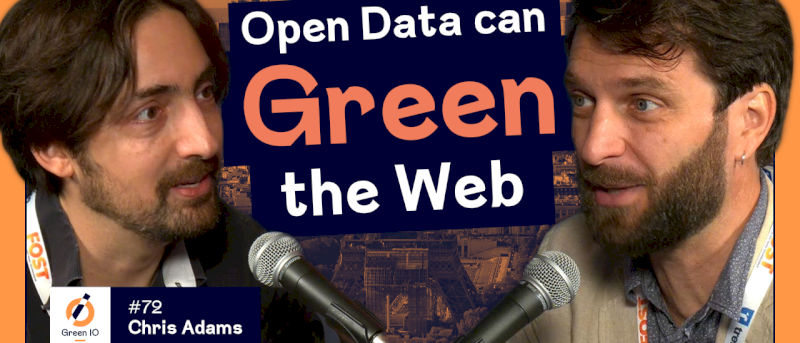
Episode 72 - Green IO Paris 2025: Making Sustainability Easy to Discover with Chris Adams
Transcript
Gaël Duez:
So hello everyone, welcome to Green IO the podcast for responsible technologists, greening our digital world one bite at a time. And today we have a very special guest, and we have a very special setup.
And for once, I'm going to be very lazy and actually, I'm going to ask my guest, Chris Adams, to introduce himself if he still needs to be. And also to introduce a bit of where we are, because that's not the usual remote recording that we have on Green IO. Chris, first of all, thanks a lot for joining. And can you tell us a bit more about you, but also about where we are?
Chris Adams:
First of all, thank you for having me. I'll introduce myself and then I'll talk about where we are. So my name is Chris Adams. I am the director of technology and policy at the Green Web Foundation. That's a nonprofit based in the Netherlands working on a fossil-free Internet because we believe the Internet should be a tool of liberation and utility for the world. In terms of where we are, we are currently in a buzzing venue that is part of the new, larger version, incarnation of Green IO. And Green IO, I learned just before this is actually part of a new Federation of conferences where we are at. So while there is Green IO here, there is also Generative, Generation AI.
There are a number of other conferences all under this much larger kind of brand of the Future of Software Technologies. And the particularly interesting thing is that rather than being in a scrappy little office, we are in a kind of reverse fishbowl situation where people can walk past where we, Gaël and I, are both very, very well lit. They can look and smile at us and hopefully, we might smile back if we see people we recognize or have new people to say hello to.
Gaël Duez:
Yeah, absolutely. This is very impressive. I guess we have between 10 and 20 thousand fans, completely crazy waving lighters and maybe that's
Chris Adams:
A little bit later in the afternoon.
Gaël Duez:
We need to share an anecdote because Chris was the fourth guest on the Green IO podcast. So you and I, it goes back quite a long time now and he was, yeah, the fourth guest. And actually he's the only one I've ever done on premise recording. The very first time was in Berlin and let's be honest, it was a bit of a disaster because we didn't have the good gear for that. And we ended up actually splitting into different rooms because of the eco. But that was a good memory.
Chris Adams:
It was a learning experience, Gaël. And now things are a lot more impressive and smooth. And I think like switching rooms halfway through the podcast because something broke was like, I think you said this is character building for us, you know, and like, here we are. It gives us a good idea of where things have come and how the field has changed.
Gaël Duez:
Yeah, it is. And let's be honest, the trend has been pretty cool when it comes to raising awareness in the IT sector about sustainability. Now, I feel a bit sorry for you because last time I met you, you were the executive director of the Green Web Foundation. And I don't know if it's related to meeting me, but now you're not an executive director anymore. And that's terrible. And I'm sure you're feeling awful about it that you're not an executive director.
Chris Adams:
I'm actually kind of okay with this, to be honest. So we've moved from a situation, actually, just like how the Green IO podcast was a relatively small thing, which has grown. So has the Green Web Foundation. When I first met Gaël, I think three years ago in person or something like that. I was employee number one at the Green Web Foundation. And over time, we've been able to grow the organization. And one thing we decided to do last year was begin a process of moving to a co-leadership setup. So now I am a co-leader of the Green Web Foundation, along with Michelle Thorne and Hannah Smith. So we have a director, we have kind of portfolios now. And honestly, I am very, very grateful for this because that means going on holidays are much less stressful process. After all, it means that we no longer leave, lose that one person on call. And we also actually have much, much better ability to kind of be focused in different areas. So I would call it a sideways promotion rather than a demotion. And I'm very, very happy with there being a deeper bench now that we've got this, actually. It's much nicer not have everything, having everything on my shoulders now. It really is.
Gaël Duez:
I can imagine. Actually, I love the way the Green Web Foundation walks its talk and talks about a more decentralized approach to doing things, open source, et cetera. Putting it also in the way you work together, getting rid of your hierarchy, et cetera. But yeah, no. So you can join the Green IO podcast, and you will not lose your job. I promise. Actually, that was more of an improvement.
Chris, I feel that we could spend three hours together because there are so many topics that I love talking about with you. But I guess maybe we should start with a very specific project that you launch, and you will be running a workshop with Tim.
Chris Adams:
Yes, around I think half past four later on this afternoon. Yes.
Gaël Duez:
And Hannah did an amazing talk as well on this project at Green IO London a few months ago. So hello, Hannah. I know that you wanted to join us, but sometimes family comes first. Tell us a bit more about carbon.txt to
Chris Adams:
We're running a workshop around this project called carbon.txt. It is a project designed to make it easy to discover the sustainability data behind various claims, or that we know is expected to come into the public domain. As we see new laws and the legislative landscape changing, kind of driving a new amount of disclosure. So this afternoon, what we'll be doing is we'll be showing people how we use carbon.txt internally to kind of point to the kind of underlying claims that people use when they say I'm running on green energy, for example. But because it's a workshop, it's designed to be somewhat interactive. So we're using this partly to say, look, this is the idea. It's a little bit like robots.txt or because it's 2025 LLMs.txt, for where you kind of find stuff. It's a little bit like that. But we are using the workshop to say, OK, what other claims are really important that you need to be able to back up with some evidence when you're, say, selling to someone or you're trying to disclose something, or you're trying to demonstrate that you're following the law in your part of the world, basically.
Gaël Duez:
And I talked about carbon.txt, I think it was a few weeks ago, to the chief sustainability officer. And I was like super excited because I'm most of the time super excited with pretty much whatever the Green Web Foundation does. So I was like, oh, there is this new cool project. And I actually felt a bit short on being able to pitch her properly. So why would a chief sustainability officer or anyone with a good enough position or a position of power in an organization push this project?
Chris Adams:
So you can make an argument based on efficiency, which is generally the idea that people are going to be asking various questions that you will need to field about your organization, like what's your track record like? If you've had to disclose a load of information because, maybe, you're in a part of the world that is covered by a law like the corporate sustainability reporting directive, where you need to list a bunch of things about, say, your record on green power, on supply chains, and stuff like that. This is one way to make it discoverable and easy to find. So you can put it, you can think of it in one way, like there is a there's a stick angle, which is the law that you and you have to follow. And here's a way to demonstrate that you're following the law. So that might be something you have in France, where directors of companies who don't disclose information, you know, there's potential jail time, or you could think about it from a kind of point of working with investors, like a carrot idea where if you make this information easy to discover, it makes it more likely that you'll be able to access to have better access to kind of green capital and stuff like that. But one of the things that we've been doing is basically like an indexing mechanism to find it find this kind of information. So if you're a sustainability, if you're ahead of sustainability, this is one of the fastest ways that you can say, look, this is our record. And here's information to back up what we hear, which is information that we have, that backs up the claims we're actually making, or in some cases, or that we're with them, or we're looking at other people. Here's where the gaps are with another organization. So it's a way to differentiate in that sense. Now, we were initially looking at the CSRD law in Europe, because that seemed to be one of the biggest laws and one of the first ones that people actually moved on to. The thing we've actually seen happen, and as you asked me about before, is like, we've seen a whole change in where the law is going these days. So we're now looking at other mechanisms or other things that people need to be disclosing or expected to disclose, because one thing that was great about the CSRD was it was a law that required organizations to publish something on the internet, but didn't say where this stuff would actually be. So the idea behind carbon or text was to say, well, why don't we agree as a consistent place to look for this stuff, if we've all agreed that this stuff should be published in the first place? And we're now looking at another law, which is called the Energy Efficiency Directive, which actually is quite a bit more focused. So rather than looking at the entire organization, you're looking at just data centers, for example, and how they're run. And given that data centers have become, I think that, I don't know, world plus dog now has opinions about this, figured one way to introduce like lights into this otherwise very heated discussion, basically. So that's the thing we're doing now. And the nice thing is that there are some parts of the world where this stuff was already published, but already in the public domain. So the Netherlands has a thing; they have a what you've had, is you've had the government basically publish a bunch of this information already, but you wouldn't know that this exists if you didn't know where precisely to look on some really obscure Dutch website to find this information. So this is the idea: making this stuff accessible allows us to have a kind of data-informed discussion around this. So that's like the legislative angle that we've been going for so far. But the idea behind the workshop is to see, well, what other options or what other uses are there that we might explore, because there are lots and lots of new initiatives where organizations are basically trying to make a kind of green claim about what they're doing. And they're not quite sure how to substantiate that. So this is one mechanism to make that easy to substantiate and provide the evidence to make it easier to trust what an organization is saying about a particular claim around sustainability.
Gaël Duez:
Okay, so there are so many things to unpack here. Just full disclosure, in France, we're the champions of bragging, not about executing. So not a single CSR or CEO will go to jail because they don't disclose for the record. I think carbon audits are mandatory to be disclosed for 10 years, and less than 10% of the French companies, you know, when you reach a certain size, obviously, but not that big. And I think that less than 10% of the French companies do it, and no fine where. So it's, it's really a problem because I see a lot of people from foreign countries using it. So feel free to use it like, Oh, look what the French have done, but they've done. No, they've said, but they didn't do it.
Chris Adams:
It was mainly an excuse to use liberty, equality, CSR, right?
Gaël Duez:
Absolutely.
Chris Adams
Yeah.
Gaël Duez:
But that being said, I'd like to put my devil's advocate hat on and say that two things puzzle me a bit. The first one is most of the time, if I'm a chief sustainability officer, I want to be the master of my narrative and what was an angle that was not really appreciated by PR, communication, investor relation, all this stuff with the CSRD was the fact that the data was super structured, that you had to report in a certain way, in a quite homogeneous way. Now it's with Omnibus. I think that we reduced by 90% the number of companies.
Chris Adams
It's about 70% in the new data points and 90% of the coverage.
Gaël Duez:
Yeah. Yeah. 70% data points in 90% of the companies that were supposed to report the CSRD. Are now not forced to say, basically a CSRD just became yet another legislation, but just for like massive companies that can actually, already handle all the teams to handle it. But in any case, most of the time, a chief sustainability officer, sustainability teams, and PR teams want to be the masters of the narrative. And if they have to drop the information in a structured, very data-driven way, no storytelling, no fancy pictures, what would be the advantage for them?
Chris Adams:
This is why, to be honest, we were attracted to the law in the first place, because to a degree, like, it's not always the job of a law to make it easy for a sustainability officer to share, like, shape a narrative. And you can kind of argue that right now, the problem we have is that there's so much narrative and so little substance that it's, in fact, basically very difficult to have any kind of meaningful data-informed discussion around, like the role of technology and society and everything like that. To a degree, like, if you're a sustainability officer, yes, you have something like you, you have like, obviously, a reason that you're going to be wanting to shape narrative a certain way. But there is also this kind of expectation that we should have the same idea of the truth and the same access to the same ground truth, so we can have a conversation about this stuff, right? And I feel like that's one of the things that was attractive to us when we were looking at laws like the CSRD, for example. Now, we have seen basically a massive push against, you might say, that there's a reason that companies don't particularly want to share all this stuff. Because when the underlying data is out there, it becomes much harder for you to kind of share the narrative to, I don't know, pay no attention to this stuff here, please. And look at just the good thing. Look at the trees we're planting here, for example. That makes it harder for you as a person who's paid to make your company look good, make your company look good rather than actually do what your fiduciary responsibility is. Like, this is the whole reason you have these laws, so that we have an understanding of the risk in the entire system, for example. And to a degree, yeah, I get that the Sustainability Director has to do that, but we also have the needs of society for things to work. And that was one of the things. So I kind of feel that, yes, you do have something like that, but one of the ideas behind designing, having these standards, is that you should be able to do both. You should be able to have a shiny report and still have the data at the end, because this is something you do see larger organizations do. For example, Google does this, Maersk does this. They will tell a lovely story about how they are supporting this and this and this. But if you look at the back, they have an appendix of really, really detailed information that is disclosed as well. And this, a lot of the time, you've got different audiences for the stuff you're sharing this with.
Gaël Duez:
And that's an important point that you make, because carbon.txt is not specifically designed for the average user. I mean, it's more like for activists, investors, because it's something that we need to automate to extract data. It's not like some part of the website where you will browse comfortably.
Chris Adams:
Yeah, like the idea behind some of this, the original thinking for the project was that, I don't know about you, but one thing that really brought me, that got me excited about the web and technology was that you can see how stuff works. Like when you look at a web page, which is made of HTML, you can view the source, and you can see the basis. If you visit a website like your bank website, you can see a padlock. But if you want, you can actually see, okay, there's a chain of certificates, so I know where the trust is going. We figured, well, these are some of the ideas that are kind of unique to the technology sector that we would really want to see more of moving into the rest of the world. So we figured, let's take a kind of transparency-oriented technology view for something like this, so that you can create those kinds of affordances for technology as well. Now, the thing we're looking at at the moment is we're actually looking at existing standards groups, for example. We're doing some work with the W3C, who have a bunch of sustainability guidelines. And one thing that people are struggling with is, okay, I'm going to do all this work to demonstrate that I'm doing the right thing, but what's the concrete thing I'm actually saying I'm doing here? And that's one example we're looking at, saying, okay, well, this looks a little bit like a claim that I'm trying to back up. Is that a particular place where you might use this? Or if you look at, say, when you're looking at maybe, say, a claim of I'm using kind of green power, for example, at long last we finally have the standards around, like the greenhouse gas protocol, on how you count electricity as green. That's being reformed. So you have the option to kind of point to the information to kind of back that information up as well. So we are seeing new places, and we're honestly trying to see where we're going to go because, honestly, the initial plan was, oh, we can totally rely on like the rule of law. Not sure we can rely on the rule of law in Europe, given that we see chainsaws being taken to all these laws right now. So we're looking at various other options to see, okay, where does this actually, where does this kind of tap into the kind of natural impulse that technologists might actually have when they think about, okay, how do I build services? How do I kind of, to a degree, disclose how some of this stuff is work, partly because I'm proud of it, but also partly because I want to demonstrate this to my peers, for example.
Gaël Duez:
It's interesting that you mentioned the W3C, and it really connects with a question I wanted to ask you. Now that the stick is more of a straw than a stick, what will be the incentive? And I'd like to connect it with one of the success stories, one of the biggest success stories in sustainability in green IT, at least, which is from the Green Web Foundation, which is a repository of green hosting providers. They are very, very proud and happy to disclose, oh, this website is hosted green. This is obviously a carrot approach. How do you plan to achieve this sort of carrot momentum with carbon.txt? Because, as far as I've seen, you don't really have a badge saying, hey, we are the cool guys because we disclose in a very transparent manner our sustainability data and so on. And I'm connecting with the soon-to-be-released W3C sustainability guidelines. I guess it will be early 2026 when it will become official. It has been around in draft mode for several years now. And that's a big part of the story. OK, we will want to be able to grade or to say, hey, we are following these rules, but to position it as a marketing strength. So, do you plan to do anything like this regarding carbon.txt?
Chris Adams:
We're still trying to figure out the W3C angle for that stuff because, to a degree, some of this is like, yes, here's how I can market what I'm doing. But there's also something I should probably share, which is that we in the world of like verifying that you're running a sustainable service, even that field has been maturing over the last few years. So we're looking to update our own verification process to bring that honesty to the standards that we see have developed around us, basically. So I think that there is one angle, which is, yes, you can make a claim, and then you can use this from a marketing point of view. And there's another point, which is basically the compliance point of view. So just like you have an accessibility angle, like there's there are various reasons you want to have an accessible website, particularly in, say, the public sector, for example. And we've now seen laws that are kind of driving this. We think that actually, that's more the direction you want to be pushing towards. And if you create something very easy to write into contracts or very easy to demonstrate when something is disclosing information or not, then it becomes quite a bit easier to actually attach this to, say, things like government spending or where large corporations are looking to do something like this. Like we know that one example is various buyers are trying to achieve goals, their climate goals themselves, where they're a lot of the time they're struggling because they're struggling to find supplies who are sharing information in a way that they can act upon or share in a way which is not under an NDA that no one else can use, for example. So that's like one of the things we're looking at. And like this is there's a story about, okay, yes, let's make it easy for the people in the marketing department or like the comms partners, sustainability group to share this. But honestly, the thing we've learned more is that it's probably easier to tie to things like procurement or things where people have to do this, not where they kind of would like to do it. Because if anything, we've learned over the last few years and how the industry has changed is that if you're relying on people's better judgment or people being nice people or corporations who are incentivized not to be nice organizations to do this, then it's gonna be the first thing that goes. And this is one of the things that we keep struggling with in this whole sector, which is that we are kind of assuming that people do this because I think it's right for the world, rather than there being either consequences for not doing it, I suppose.
Gaël Duez:
If you enjoyed this interview, please take 30 seconds to give us five stars on Apple Podcast or Spotify or a like on YouTube. So I think we are now sustainability experts turning more than 40, but we will not disclose exact numbers, discovering that money rules the world. And that would rather follow the money and the procurement money, especially to achieve meaningful results, rather than I mean, honestly, we know that doing the right thing is also what will create the sort of bottom-up momentum that initiates things. But when we want to scale, following the money and following the compliance angle could be a good one. And you do believe that carbon.txt should help us achieve this?
Chris Adams:
Yeah, so the thing we're looking to do is even if you don't want to do something, we should at least make it easy if you understand what you're doing. Understand, like if someone asks you if a big buyer is asking you to disclose and link to this information, you might not want to do it. But if it means that you learn that contract, that means you get to pay staff for the next like nine months, then yeah, you'll accept it, and you'll do it right. So the thing we're trying to get is set an expectation that yes, this information should be there. And the thing is also worth being aware of is that we're now in this world where, where there's, I guess, the thing we might have seen the last four months is like the mask coming off a bunch of very, very large companies who've been presenting themselves as climate leaders. And then when you see push comes to the shove, that's not the case, right? So, therefore, there's now a renewed interest in Okay, what role does the technology play as data centers and technology companies play here? What does the social license look like? And the idea is if you can make some of this data available, then you can actually have an informed discussion around this because right now, it's not a particularly data-informed discussion on either side. And you might have people, you have one group who's basically saying, our crap doesn't stink, right? And then you get the other side saying, you got other groups saying, Okay, I hate this about the technology sector, and they're using too much water and too much energy and everything like that. And like, to a degree, there's no shared truth, there's no ground truth to have a kind of like, useful conversation about this stuff.
Gaël Duez:
I agree that we're trying to have these conversations at Green IO conferences, but for sure, it's pretty hard to follow. You mentioned something that I'd like to follow up on, which is that the mask is off. But before that, very concretely, how can we help you? By that, I mean, if I had, I mean, I don't even know if there was a right person to pitch, but if I were to meet again, my chief sustainability officer, what do you need? What do you need to make?
Chris Adams:
I'd ask the procurement officer to come along, not the sustainability officer; they have the power. They're the people who get to control how money is spent. So I would probably say, yeah, the most useful thing to do is bring the person who gets to control how money gets spent, because sustainability officers don't necessarily get to control that.
Gaël Duez:
But it comes, I would say, with the demand side and the supply side. By that, I mean, whenever we need a procurement officer willing to do good things, we say, hey, you know, just add a little line in your procurement spreadsheet saying, can you please disclose the link to your carbon.txt file? So that's, I would say, the demand side. But from a supply side, I guess you also need a lot of companies starting to disclose carbon.txt. How does it go? And yeah, how can we help you to achieve these goals?
Chris Adams:
And to be honest, actually, you've helped us already by giving us a space for the workshop to test some of this out. Because the thing we built was like we built a bunch of tools focused around one set of laws, like CSRD. Alright, that's not the only thing people need to disclose. Right. That's why we're looking at something a little bit smaller, because we figured, oh, let's let's let's bet on this massive law that turned out to be a huge target as well. So, therefore, when we were thinking, oh, we of course, there's gonna be all this data in the public domain. And it's all going to be like, passable. So we designed all these tools so you could pull out precisely the data to play two points you wanted. And then we saw like, this totally different total change in the law, whether you weren't seeing that. So now we're looking at something a little bit more focused and a bit less of a huge target, where we know there's something concrete. So we're looking at, say, the ED as one example right now. But there are other things that you might want to point to, you might need to point to, that are in the public domain that are useful to kind of back up some of the claims that you actually have. So honestly, the thing will probably come to the workshop we have this afternoon, and talk to us about the claims you need to make that you're able to share in the public domain, which will also help other people.
Gaël Duez:
And Chris, I know I want to go further on what you mentioned on Big Tech. But before that, I'm realizing that this discussion is very European-focused, we're mentioning the ED, those are European Efficiency Directive, and the CSRD. Truth is, sustainability is happening all around the world. And a lot of countries in Africa, South America, and Asia are passing laws that are quite ambitious. Even China has passed laws that, you know, could be called the CSRD, like so. So we're a bit opaque about what is actually happening in China. But my point is, do you target or do you already have contact with companies based, I don't know, in Kenya, Brazil, etc, using carbon.txt? Because that's not supposed to be something focusing only on European laws.
Chris Adams:
I'll be honest, we've been looking at the USA more than Kenya or Brazil so far. And the reasons are is that both in New York and in California, you've got two sets of laws, which have very a lot have some similarities to the initial CSRD kind of proposition, the idea that you need to understand the risks associated in your system in the system, for example, and New York and California, they're the two of the three largest economies in the United States. So they are honestly one of the two of the places where we're expecting where we're currently speaking to people to see, okay, well, is that a potential place for us to spend some time? Because also, from a like, just a development point of view, it's actually not that the underlying tech we have that passes CSRD reports, actually can pass the equivalent reports in both California and in New York, they are using the same underlying technology. So those are the ones we're looking at the moment. But we've been looking at like place like Canada as well, which has some interest. But those are the two ones we've prioritized first, ahead of Brazil, simply because those are the areas we know better so far.
Gaël Duez:
And did you explore a bit of Singapore? Because what Singapore does, a lot of Southeast Asia does. And honestly, they've been quite spear-heading the sustainability angle a lot from a green business perspective, let's be honest, they don't necessarily share the same approach than in Europe, but they're doing good things as well. And I was wondering if you should you guys should do a similar workshop in Green IO Singapore, and be connected with IMDA and so on. Because honestly, the Singaporean government, when it decides something, it's usually pretty efficient. And if you can imagine that it says, Oh, it's pretty, pretty useful tech tool. Yeah, I'd like to, to have all my call for tender. We're requesting it.
Chris Adams:
That's a really good idea. Actually, Gaël, you know, I think one of the reasons we haven't been looking at Singapore is simply that we just don't have any people in Singapore. Like we have people in Taiwan, and there's some interest there. But it's largely that we've, we have organization like seven or eight people, right? Like, maybe eight, if you include like the full time full time equivalence, right? We have one person based in Southeast Asia. And like, just keeping up with European law and all the changes is quite a lot. And it may be that actually there's a tree we should be barking up, actually. Thank you for that.
Gaël Duez:
Well, to the few hundred green oil listeners every year coming from Southeast Asia, maybe you should reach out to the Green Web Foundation, because I really believe this is the sort of project that connects both some sort of business mindset and technology mindset that could work in a place like Singapore and other Southeast Asian countries. But let's, okay, let's talk about it a bit later. I'd like to go back to something you mentioned, as Big Tech masks went off. From a broader perspective, you're one of the most, I would say, knowledgeable witnesses of what happens in green IT and in IT and sustainably at large over the past years. What are the main trends that you see? And obviously you mentioned green tech and AI, but that's not the only one. So what is happening in sustainability in the tech industry?
Chris Adams:
I think one of the key things we've seen in the last few years is towards the end of the 2010s and the beginning of the 2020s, because I guess, like people who are in technology worker roles, felt like they had a much greater amount of positional power. They were much more prepared to kind of like demand certain things and to a degree, like you might link it to say, zero interest rate phenomena or stuff like that. There was an idea that, like, okay, we're, we're in demand, we have quite a lot of negotiating power just individually. So, therefore, we can ask, you know, we can push for conditions that make us feel quite happy with who we are, bring our whole self to work, and everything like that. And also to a degree, if you look at, say, the technology firms themselves in the wider kind of commercial environment, like stock markets and everything like that, there wasn't the same kind of pressure on technology firms. They were able to kind of grow for a longer period of time without the same kind of activist investors pushing them to kind of fire loads of people, kind of give it back a dividend, everything like that. And I think one thing you've seen is that as technology companies have been around for longer, they've stopped just being seen as new and special and just been seen as new. So therefore, you have a lot of the same rules being applied, and to a degree, for people who are technology workers, they have somewhat translated and they're not having the same kind of power that they had before. And as a result, previously, you're saying, Oh, I really going to push for us not doing some work and say, let's say, let's say there's something like this, it is a drone program or something like that. You say, I'm not going to do that, for example, you've seen people who would who are doing that who are basically, rather than being tolerated, they would just be ejected from the company. So you've got organized that you've got workers themselves having much more being in much more precarious situations. And that's kind of translated into like the sustainability goals, because a lot of the time you've seen, when it comes down to either maintaining your share price or hitting your targets versus keeping to your existing goals. You've seen publicly traded companies that are incentivized to basically chase their quarterly goals to be exactly what they're designed to be doing. And I think one thing we've seen is that we haven't been able to maintain that power to kind of fight against some of that, basically, or to kind of redirect it. And like the big, the really good examples are some of the largest companies basically saying, Oh, we had a moon shot, but the moon has moved. You know, this is the whole idea, like, where, like a moon shot, I thought the whole point of a moon shot is you fly towards the moon, not away from the moon. You know, like I'm telling Ketan Joshi when he says this, but like Microsoft is a really good example. As the moon has moved like, no, that's not what's happened. You've decided that you're going to chase AI because that's the thing that is considered the thing that if you don't do, you're going to lose your market share and go, and that's going to impact your share price. And you see the same thing with Google as well. Exactly. Now, we may see some of these companies still hold on to some of the goals they have about, you know, entirely clean power by 2030, for example. But this is something that's up in the air. And I think it's looking a lot more dicey now than it was at the beginning of the 2020s, for example.
Gaël Duez:
In the tech industry, do you believe that the Big Tech companies will, at some point, when they all the AI hype will slow down? I'm not saying that AI will disappear, but not at all. This is what but this sort of bubble that you have to you have to you have to when it will cool down. Do you believe that they will go back to the initial sustainability plan or that they're now on the path of a very extractivist and market share price optimization that will force some of us to reinvent the tech industry? So, can we answer my question, because I'm not super clear here. My question is more. Do you believe that at some point we will be able to play again with the same Big Tech players or that the market has significantly changed and we need to find other actors really willing to build a more sustainable tech world?
Chris Adams:
Large companies respond to incentives, right? And right now, with no other kind of forcing like entities, I think what's likely to happen is they're going to continue doing the stuff they are doing so far. Because honestly, share prices have been going up, and they've been able to kind of continue, you know, they're still able to like sell and grow at the rate that they've been growing. Like if you see growth slow down or if you see maybe the AI bubble popping, that might change people's priorities because suddenly, like if one of the things that you're you're seeing is existential because you have other organizations trying to do a massive land grab, where this new technology that you're worried about being used against you, if that turns out not to be a thing that people are shooting or fighting over in the same way, then that does give you a bit more space where rather than having to like argue for ever more amounts of data center build out, there are other things you can say, well, maybe we can we can focus on efficiency again, we can focus on these other things. And also, it's worth bearing in mind that, like the economics are changing kind of in favor of like cleaner forms of power or like more sustainable technologies, broadly speaking, but you do need like some kind of forcing function at a governance level to really change this. And we were assuming that would be the rule of law, and like governments right now. But what we're seeing is a significant amount of regulatory capture, which makes it much, much harder. So maybe if you want to see anything like the kind of power that technology workers enjoyed towards the end of the 2010s and the very beginning of the 2020s, maybe you need some organization so that there is something that is a useful, powerful counterweight to what you have elsewhere, because other sectors have this. They have unions that have to be who were in some cases, even on the seats of companies, for example, there's all this stuff that you can do that we don't really argue for. And I think that some of the stuff you would need to do needs to think about a structural level to enable the change of some of the incentives, because right now, I can see why people who are in a management position in a publicly traded company will do the things that they do. I don't agree with it, but I can see how they arrive at that decision and how they're incentivized to do that, for example.
Gaël Duez:
They follow the incentives for sure. And maybe to close the podcast, because we have literally hundreds of people to meet. So do you believe that all the trends could be worked with, or are beneficial, or create some sort of synergies with the sustainability angle? And I'm especially thinking about the resiliency angle. We've seen what happened with both Cloudflare and AWS in the last couple of months. So people are realizing that what the tech takes for granted is not that obvious. And also the FinOps approach, like all these huge bills from cloud providers and more generally tech providers, is soon getting completely out of control. I would say and going nowhere. And then suddenly, the chief financial officer is starting to be very worried about them. So, FinOps and resiliency, do you believe there could be concerns that we could piggyback on as sustainability folks, even if I also do care about money and resiliency, or are there different battles and we shouldn't mix everything?
Chris Adams:
OK, so I think you're asking, OK, we tried the moral case. The moral case turns out to be not that effective when dealing with publicly traded companies that are incentivized to ignore moral cases. So are there other things we can use instead? And I think I think the answer is yes, you totally can use other ways or other kinds of forcing functions, for example, like in Europe, for example, there's a whole thing around sovereignty, which is a little bit like, let's zoom out for a second. We look at the world of sustainability, and we often look at China as an example, saying, oh, yeah, look at that economy. Isn't it awesome that they're moving away from fossil fuels, or they're deploying so much renewable energy? Yeah, there's a moral case for solar compared to, like, say, building your entire society on fossil fuels. But it's also a really good way to avoid being dependent on importing huge amounts of fossil fuel. So you can totally see the economic case that was given there more than the moral case.
Gaël Duez:
Plus, from an import perspective, but also from an export perspective, because they've built an industry.
Chris Adams:
Yeah, like we can't compete with it with an internal combustion engine. So we're going to own the future. We're going to go for EVs because we know that means we're no longer relying on external suppliers. And like, yeah, you can totally do that.
Gaël Duez:
And that's really connected to the narrative that, you know, we talked earlier, because I really have to share it with you. I'm sure you've seen it, but you know, all this narrative around Chinese, saving the world, et cetera. I think it was the Internat-, I think it was the International Energy Agency recently who shared a report saying that basically, 90 percent of the carbon reduction achieved by China was more linked to the deployment of high-speed trains rather than EVs. And that the amount of carbon emissions when the high-speed, amazing Chinese network grew up dwarfs the emissions existing in predicted by the airline industry and also from, you know, road traffic. And that, actually, electric vehicles' share in the decarbonisation of China is not that big. And that's very interesting because that doesn't come from a very activist-minded organisation, that there is also a bit of a narrative in some countries around which sustainable battles they pick and how they promote solutions, even if it's not the most efficient one.
Chris Adams:
I don't actually know that much about the kind of impact of high-speed rail versus what you would have otherwise had in China, for example. I do know that a shift towards EVs, not just electric cars, is like taking millions and millions of barrels of oil demand off. Yeah, globally. So that's the thing that we're seeing there.
Gaël Duez:
But that's even bigger than the high-speed train savings in terms of carbon emission, are in an order of magnitude bigger. And I was as surprised as you when I read it, like it's obviously very good to achieve EV. But honestly, the US should build a faster speed train network before even shifting to EV if they really want to achieve a meaningful result in carbon reduction. But that's me going off trail. Sorry.
Chris Adams:
So we were talking about sovereignty. Are there other ways? But the things you can tap into. So, yes, I think there are. So there's a whole discussion around sovereignty, not just in Europe, but also from a kind of like a corporate point of view. You're like, well, I'm stuck with one supplier and I'm I don't understand my bill. I have to pay someone else to basically help me make sense of my bill or buy a bunch of software, so I can make sense of this bill to make it available. Right. And like you and me, we both know that like cloud and computing, these things are they're commodities, really. They're often kind of like vertically integrated, so it's harder to see that. But the introduction of things like AI with all these neo clouds, which are kind of interchangeable from we know if I'm buying it from CoreWeave versus Amazon versus say Microsoft. If I'm buying just like inference and it's not tied to a particular model, that's kind of a commodified tool there. I think there are things you can actually do to say, well, OK, do I want to be locked in so much to do a provider? Do I want to actually have something more like a kind of OK, forgive the phrase, but like a single market for this stuff where there's competition around here, where there's the ability to move around and choose suppliers? I think there are things we can we can tie into there. And there are also ways that I think you can provide a kind of basis for competition to allow people to compete on on different criteria, for example. So I think there's something like that. Now, there's a discussion about whether we want to move in there. Like we've been right. We've been maintaining a directory of say hosting providers, right? We need to have an internal discussion about if we were to say, are going to tell people about all the green inference providers? Right. Because that's there's a whole moral discussion there. But like that's some of the stuff you see. And like that's one thing that you are seeing interest, even if it's not particularly well developed right now, you're seeing it in Europe right now, because it turns out that if you're a lot of the same companies that have to import fossil fuels also have to import compute services. Right. So like, you know, you can see quite a lot of similarities inside this in terms of, OK, how what supply, what dependencies do I want to have? And where do I want to be buying it from? Especially if I know they can switch things off or lock me out like we've we've seen how access to fossil fuels has been weaponized over the last five years. We're seeing how access to digital services are being weaponized like
Gaël Duez:
Mastercard and Visa for the Russian government, for instance.
Chris Adams:
The International Court of Justice is locking a bunch of people out in the US for some court cases, for example. There are things you can see here, which is, I mean, this is more like a kind of geopolitical angle rather than a moral case. There are things like that, but this requires a different switch in how we think about this, I suppose. And that's probably why we still do stuff with technology, but we're getting more involved in, honestly, kind of policy and figuring out where the other kinds of points of leverage are that you can be pushing for this stuff.
Gaël Duez:
That's interesting. I try to summarize this discussion because this episode is going to it's going to have to stop, unfortunately. I would say that the moral case has helped us build a community of concerned or responsible technologists. I would say that is still fueling all the energy that we can see in all these NGOs. And this is a great place, obviously. So, now we have the case of finding new ways of achieving our goals, you know, built on these very strong foundations, which are these responsible technology communities and all those NGOs. And these new ways of building things are way more related to the resiliency angle, the sovereignty angle, and the financial angle. OK, and this is also why we see a bit of a shift from the Green Web Foundation, from let's build very technological tool designed for responsible technologies to let's build tools that will connect the gap or build bridges between the tech world and the other main functions in a company world, such as sustainability, procurement, investor relation, legal, etc. Is it the right way to summarize what you've been saying for the past hour?
Chris Adams:
Yeah, I think that's I think that's about right. So when we when I first joined the Green Web Foundation in 2019, when we like rebooted the organization, you might say the theory of change was about let's help a small number of small providers do the right thing. Right. However, we've seen this massive shift in how the organization works, how the industry works and where power has been moving to. All right. And there's also been like discussions about, OK, well, rather than just talking about something which is poorly defined about green energy, do we want to be looking at, like, the like is it OK, it's solving it at the hosting point. Is that the right place to solve it? Do you want to save it somewhat? Do you want to try and solve the problem slightly further up the chain, for example? Right. That's why we've been experimenting with OK, where are the places we can interact at the law at the legal side, for example? That's one thing we're doing. And there is also this one thing I'm just going to plug. One thing we're looking at doing now is now that we've been able to start interacting at a more structural level, one thing we're looking at doing is working with other organizations to act like to share some of the lessons we've learned and provide some of the support for this. So we start to move into providing fiscal hosting for other organizations that are also looking for structural interventions so they can work on similar projects like this. So we're looking at the kind of we're taking a systemic view rather than just the can I switch my provider as someone who's like a tech lead, for example, is there there's a there's a whole gamut of interventions that we can actually support. And I think that's the thing we're looking for and moving towards basically as we kind of grow up and turn into like a proper grown-up NGO.
Gaël Duez:
And for whoever is interested in reaching out either to you or to this grown-up NGO, as you mentioned, the Green Web Foundation, how should they do it?
Chris Adams:
We've actually just, so if you're running an organization and you're looking to kind of raise funding and start working with, like, say philanthropy and stuff like that, we now offer fiscal sponsors. We're experimenting with fiscal sponsorship. We're doing it with one organization. We'll be announcing in 2026. But we're doing more like this. The simplest thing to do is Google the word Green Web and you'll see our page, and you'll see, and you'll see the stuff, and we have news and our services. There are a whole lot of things that we're listing and making available for people now.
Gaël Duez:
OK, excellent. Chris, thanks a lot for joining the show again in this very specific setup. And I wish you a very good workshop this afternoon.
Chris Adams:
Thank you, Gaël. It's really nice to be back, and thank you for providing this space. And yeah, look how far we've come.
Gaël Duez:
It's just the beginning, my friend. Thank you. Green IO is a podcast and much more. So visit greenio.tech to subscribe to our free monthly newsletter and check the conferences we organize across the globe. I'm looking forward to meeting you there to help your fellow responsible technologists, build a greener digital world, one byte at a time.
Join +3,000 responsible readers

Green IO newsletter
Once a month, carefully curated news on digital sustainability and Green IO contents delivered in your mailbox