Podcast
Episode 73 - Gerry McGovern vs the Growth Death Cult
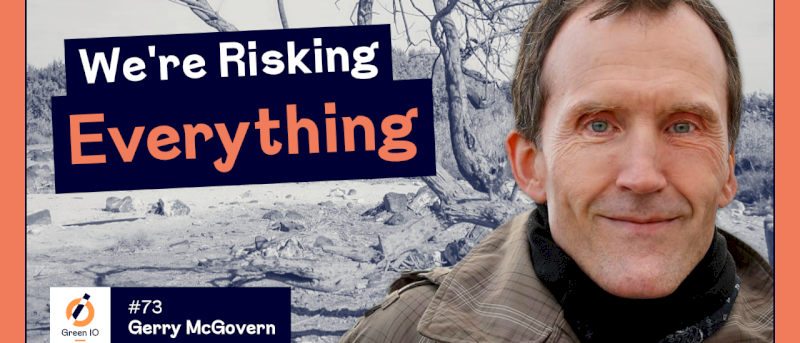
That’s the 8 billion-person question. And here to help us answer it is a returning Gerry McGovern, back to share everything he’s learned during the making of his new book, ‘99th Day: A Warning About Technology’. 📗
Throughout this insightful discussion, Gerry and I wrestle with a central thought:
Does technological advancement automatically mean societal and environmental decline?
We discuss Gerry’s unique writing style, his journey from rock’n’roll to technology journalist, how he found his calling and hopes for the future.
Transcript
Gaël Duez:
You might not think so, but there's a lot we, technologists, can learn from indigenous philosophy, at least according to Gerry McGovern, and from the Silicon Valley death cult to his radical view on AI, many other provocative stances were shared in this packed episode.
Hello everyone, welcome to Green IO. I'm Gaël Duez, and in this podcast, we empower responsible technologists to build a greener digital world, one bite at a time. Gerry McGovern is back on the show. Yes, the very same Gerry McGovern who wrote World Wide Waste. Yes, the book that pretty much everyone in the responsible tech community has mentioned to me as an eye-opener. Not forgetting to mention his weekly newsletter where he covers the social and environmental impact of our digital industry with gloves off, and the lucidity of someone who has been in the game since its very beginning in the early 90s. Gerry's new book has just been released on February 1st, and he has kindly accepted to join us to discuss about this massive piece of intellectual work. Welcome, Gerry, welcome back on the show. It's great to have you today.
Gerry McGovern:
Oh, thanks a million for inviting me back. It's lovely to be back.
Gaël Duez
I have to tell you that the first chapter of your book really touched me, I would say, emotionally speaking, and it's entitled The Confession, and I think it will resonate with a lot of people working in the tech industry. Could you tell us more about it and why you started an entire book about the environmental footprint of the tech industry by The Confession, and what does it says about your personal journey among all these topics?
Gerry McGovern:
I came across the web very early, I was kind of a mix between a rock and roll and a technology journalist back in the early 90s, and I was doing a report or an article on how journalists found their sources, how they did their research, and somebody said to me, "Hey, you should check out this new thing called the World Wide Web, it's going to be great for journalists to find out information and do research." So I think it was the NCSA Mosaic browser, it was very, very early on. I just thought it was amazing. I had this image, which later I came to regret in a way, but I grew up on a small farm watching black and white television of the westerns, going out, and the wagons going out west. And of course, later, I learned of course that many of those wagons were bringing genocide to the Native Americans. But for me as a young child, there was this amazing open space and adventure and the future. I saw the web, I kind of saw those wagons going out west. I was kind of drifting at that stage. I was in my early 30s, and I didn't really have any real focus. And I said, "This is what you can focus on, this is what you can really make a life out of and have a purpose." So it all felt like, "This is what I want to be really involved in and focused on." So I jumped into all that, the whole web, and wrote out the first report for the Irish government, published in 1996, called Ireland, the Digital HD Internet. So all sorts of stuff. I was a true believer, and it's not that I'm totally a disbeliever now, but there was a whole series of great disappointments which began to occur maybe from 2017 or 16 onwards, maybe with the election of Donald Trump. And I said, "How can this be happening in the most technological society on earth? And what does this say about a technological society if somebody like this can come to power?" Because we all had the impression, or a lot of us, that the more information we made available, the more educated the population would become, the more skeptical it would become, etc., etc. It was a good thing. And then Greta Thunberg started her protesting, and I thought, "Oh, she's amazing. It's maybe naive, but it's a beautiful naivety and a type of naivety that I wanted for myself to get rid of a bit of cynicism." So I started around 2018 researching for the book World Wide Waste, which I published in 2020. But I didn't think I'd find it much because I totally believed in it. I was installing solar panels in 2010. Heat pumps the same year.
I was very much into and totally believing in digital as a good transformer, a positive environmental transformer, etc. So I thought I might find a little, but not a lot, in relation to reducing the impact or improving the impact of digital. But the more I dug, the more I found. And I first discovered e-waste. I never thought about where the computers go. So that was a real eye-opener and awakening. And then World Wide Waste came out. But I still don't think you could say World Wide Waste is an anti-technology book. I think it's, "Hey, we can improve. We can get better at what we're doing."
Gaël Duez:
I think a lot of us have experienced World Wide Waste because, as I mentioned in the intro, it is a book that is mentioned countless times whenever you meet other responsible technologists. We've experienced it as an eye-opener. Like, oh, but we are acting as spoiled children, wasting precious resources to an extent that is barely imaginable. And that's it. And by that, that's it. I mean, we have homework to do, but a bit like the industry, like the regular industry should do. We didn't see the waste. So that was issue number one. Now that we can see it, we can quantify it, we can act more wisely, I would say. And yeah, it was a true eye-opener for many, many people. That's why I guess your book is so much weighted among this community. But now you're telling us that your journey kept up after World Wide Waste?
Gerry McGovern:
Yeah, like that's great to hear. Because I kind of think the things you do, sometimes you think they have some importance, and then other times that's just gone into a void. But I started doing a bit of a podcast just to promote the book. And one of the scientists I interviewed on it was Josh Labowski, an amazing person, a wonderful person, a tremendous scientist. And I was totally focused on digital waste, e-waste, and all that. And he was saying, yes, that's important. There's no question that's important. But if you really want to understand the story of the modern technological civilisation, look at mining waste. Because for every tonne of e-waste, there's perhaps a hundred or a thousand tonnes of mining waste. And initially, I thought I was kind of annoyed because when you're on a track, and you're focused, and you think you found the area that's the big issue, and I was thinking, what's he talking about mining? Because mining waste seems so, I don't know.
Gaël Duez:
Massive compared. And also, it's sort of a proportion. I mean, all our devices are so small, and our entire industry seems so thin, I would say. And mining seems so big that we relate mining to construction work, to a car rather than a tiny and shiny smartphone. So there is this sort of cognitive dissonance.
Gerry McGovern:
There's a cognitive dissonance. But for me, it was mining. What's mining? I knew what kind of happened, but as you said, it was no part of my world. I'd never even thought about it in the process. So that began the journey that really is the book, Ninety Ninth Day, the story of mining from the point of view of digital metals, green metals, or the metals that are in certain iPhones, maybe a quarter, can be aluminium. So that was the first metal I said, "Well, let me see about aluminium." And by an amazing coincidence, I discovered that the biggest factory has two stages in aluminium processing. Stage one is the bauxite, which is the clay or the soft rock turned into alumina. And the biggest place to do that in Europe is in Ireland. So I said, "Wow, I never even heard of it." So that began the journey. So, Ninety-Ninth Day is looking at many things. But as you said earlier, it's a real journey deep into mining and the impacts of mining.
Gaël Duez:
That's interesting because I wanted to ask you a question, and I'm sure many of the listeners will want to understand why this title, and for the people who didn't read the book, which is most of the people, because it will be released in a few days, why this title? And there are, of course, some answers in the book, but could you please elaborate a bit on this?
Gerry McGovern:
Well, it's like this idea of exponentialism and our inability to understand the impacts of... And it's in so many stories, like for years, people in the data center industry were telling me, "The electricity use is not important. It's less than 1%. It's less than... It's not even considering it. It was doubling at 0.2, 0.4, but it was less than 1%, and then suddenly it's 6%, and it's 12%. Oh, what happened in the process?" And there's a story that's often told or a riddle that's often told. And I think it was about 30 days rather than 100 days. Mine is a 100-day story. If some sort of green slime was covering a lake and it took 30 days to cover the entire lake, and it was doubling every day, how many days would it take to cover half of the lake? And most people found it challenging to say 29 days because mentally it doesn't seem right in the process. So this is about that this thing is happening, and in 100 days, it's going to have an incredible impact. And we're basically on the 99th day, the day before, that incredible impact really occurs. And in essence, as well, on the 99th day, you almost can't do anything. It's too late. You should have acted on the 90th day or the 80th day in the process. But on the 99th day, the momentum is just too strong. So the book is about collapse as well. The second chapter begins, and the collapse is coming. That's my reading of 200 pages of references or whatever, and talking to loads and loads of scientists and researchers, that we are not so much that humanity is beyond saving, but that this civilization is beyond saving.
Gaël Duez:
A quick word about the sponsor of this episode, Resilio. Resilio provides leading data, tools, and professional services to assess and reduce the environmental footprint of tech. As a Green IO listener, Resilio grants you a one-month free trial access to the Resilio database, a search engine for the footprint of any IT equipment or services. Find the carbon or water footprint for tens of thousands of products in a click and so much more. The link for this special offer is in the show notes. Full disclosure, I only accept partnerships with companies whose services or initiatives I personally support or use myself. As usual, however, I'll let you be your own judge about these products.
It's interesting because quite often I illustrate the exponentialism with this sort of metaphor that you've just used. I've never heard about this one, like this riddle, like how many days before it covers half of the lake. And I really love it. And I think I will lend it to you, but I never connected it with the thinkers and the thought leaders around collapseology or collapse studies, I would say. People like Pablo Sevignier, especially well-known in France for this, but I think across Europe as well, that if we wait too long, even if the amount of what is visible doesn't seem to be that bad, it's already too late. And that's what I really enjoyed with the metaphor that you used in your book, that it's maybe too late, even if we think, "Oh, that's okay. We've still got half of the capacity, but the next day we've got zero because it's an exponential growth." And actually, so we mentioned several times, mining. I've got just two short questions before we jump into what the main focus of your book is. But the first one is the style of your book. I mean, you've read a lot of very short sentences, some of them without a verb. And I was wondering, was it gut-filling writing? Was it more the way you usually write? I remember then World Wide Waste, it was more like, was it literate English? I'm sorry. I'm not an English critic. It's not even my native language. But the style, I thought, the message was also conveyed by the style that you've chosen for this book. Could you tell us a bit more?
Gerry McGovern:
Yeah, well, it's a style, I suppose, I've developed over the years. I mean, I essentially see myself as a writer. It's what I've been doing. This is my ninth book. Though I worked building websites or managing large data environments, that's how I made my money. And how I got in the door was usually as a result of an article or a previous book that I'd written, and somebody in the company said, "Hey, can you help us do that?" So whatever skill I have, the core skill is somehow around the use of words. And the book is fairly well written. I went over it many, many times. So it's not just written once, so to speak. And it is maybe not as polished. Somebody said, "All writing is ultimately abandoned." You can only bring writing so far; you can never ultimately achieve absolute perfection. But maybe I was trying to get this sense of urgency or momentum building, a gathering storm, or a gathering force. But I worked it as hard as I could to make it as well-written as I could make it. It was very stressful because it's a huge book. I often felt like I was too big and I just wouldn't be able to do it. So there were many times it really got me down trying to bring it together, trying to give it shape, trying to edit it properly, trying to... So it took a lot out of me to do it, but I hope... Well, I've done it the best I can do.
Gaël Duez:
That's sure that it doesn't look like a book written, as you say, written once. And let's move to something else. There is clearly a style that you developed, but a very punchy style, a very short tense, conveying tension, I would say, about what you believe is the urgency to deal with. And you mentioned the size of the book, Gerry. Yeah, I should warn the future readers that it is a big book. It is almost 600 pages plus 200 pages of resources, of links. So I have to tell you, how did you manage to gather so many resources? I mean, is it actually... Are you working now exclusively on a book, newsletter? Pretty much. You mentioned that you used to do some consulting, but you don't do consulting anymore.
Gerry McGovern:
I do a tiny bit. I thought I could dedicate... I've had a pretty good career. I've been fairly successful. I can dedicate myself to this. If I really want, I can come up with excuses, but I don't have young children. I don't have a mortgage. I looked at the situation I was in in life. I'm in a very, very lucky situation financially that the vast majority of people are not in. So I basically... Yeah, every day, often every hour of every... I'm reading or checking up on this source and that source. And yeah, I really went after to try and get a comprehensive view from a research point of view, what people were saying, and did this reinforce this? I hope I didn't take a point that I hadn't found four or five or six times in different areas. Because with everything, with the slop that comes from AI, it's very hard to know what to trust anymore. So one of my ways of building credibility is this point being said by this person, this person, this person. And if all of these other... They all seem to be fairly respectable. If they're all saying it, well then, there's probably something in it.
Gaël Duez:
So it makes total sense because I was really wondering, and it's also maybe why you have such a strong voice and an independent voice by being also financially independent at the end of your career at the beginning. Not willing to mention your age, but you're not especially a rookie, I would say. Exactly.
Gerry McGovern
No, no, no, no, no, no, I'm 63. So I'm lucky, as you say, because it's so... I think if I were 20 years younger, I wouldn't have believed myself. I would have said, I'm not reading this book. I'm not... We have so much pressure. I admire younger people because there's so much pressure, and it's so harder for your generation to make a living, an apartment, and the pressures to conform financially and in all sorts of other ways are incredibly strong. So me looking at this 20 or 30 years ago, I don't think I'd have believed myself.
Gaël Duez:
And that's why we also need people to have this sort of liberty, this freedom of being able to embrace the big picture we have in too many of these financial constraints. Voltaire used to say that we think about liberty when we've got a full belly, and I think it's something that should be remembered quite often. Now, jumping on the core topic of your book, as I mentioned a bit earlier, you dedicated more than half of the chapters to mining. So why did you choose this specific angle, and what are the main messages? I don't know, the top two, top three, top four messages that you really want people to get out of this massive focus on mining.
Gerry McGovern:
We have our environment, what we call our environment, and it's got fresh water, and it's got generally clean air, and it's got good soil. I mean, that's the environment we come out of, and lots of forests and mountains. That's our environment. There's an old saying, you never walk into the same river twice because the water is always new water, but you never walk into the same environment twice either. Our environment is always changing, and if we wait long enough, it will become an environment that's not really suitable for us, no matter what we do. Even if we're the best stewards and the best ancestors, things will change. Ultimately, the sun will explode or whatever if we wait, but everything you do in some way transforms your environment. Some things you do can transform it in a better way, and by better, I mean better for us. So you could make the water cleaner, you could make the air fresher and cleaner as well, the soil richer, but some things you can do to make the environment worse. My name is almost always, I've never really found an example of a positive or a negative transformation of our environment. So over time, the toxic gases and the poisons and etc, a lot of them sank. They might have stayed on the surface for a billion years, but when they were on the surface of the Earth, we couldn't evolve. It was only by the removal of these things that were not conducive to life from the atmosphere, from the water. Oftentimes, they became trapped in rocks or else went deep into the earth. So when you mine rocks, you often release demons from the point of view of a human point of view, because you release all sorts of metals or toxins or things that were trapped. By definition, they were trapped; they were taken out of our environment. So they're not in our environment, which is a good environment. So if we bring them into our environment, we change our environment. So we are radically changing. At this point, we are heading towards mining Mount Everest every year, every single year. So Mount Everest is about 175 billion tonnes of material. So to maintain our modern civilisation, we are digging and blasting and collecting and then throwing most of it away because most of the mining processes are actual waste. Mount Everest, you cannot do that every year and maintain the same environment. So we are basically changing our environment much faster than it would change under normal conditions. And as I say in the book as well, it's a death cult. We have become part of that through the mining process.
Gaël Duez:
Well, that's quite interesting because I really want to dig into, pun, not intended, sorry, this death cult. Just to wrap up what you've said, here are two things, and please correct me if I'm wrong. The first one is the unsustainable pace of mining. You mentioned the fact that at some point, we will mine the equivalent of Mount Everest in minerals. So before it has been refined into metals every year. I think that's a study from UK academics, by Melvin Vobson, am I correct?
Gerry McGovern:
Melvin Vobson is certainly one of the people who was talking about that. He's a tremendous physicist.
Gaël Duez:
Yeah, he's a physicist, and he's one that actually tries to give some weight and some consistency to the information he manages, actually, and it's pretty impressive. We haven't reached this date yet when we will climb Mount Everest. I think he was mentioning 2045.
Gerry McGovern:
It's not far away.
Gaël Duez:
Yeah, it's not far away. Yeah, absolutely. It's less than a quarter of a century. So there is point number one, it is unsustainable. I think this is maybe more and more understood by many people that this growth rate is not sustainable in extracting more and more and more copper, aluminium, or bauxite, actually, so-called rare earth, but we'll come back to this point. So this is this unsustainable trajectory. But what you mentioned, and that's the second point, and I've really actually never paid attention to it, is that we are digging out demons from the past. That's a poetic way to say it, but more pragmatically, we are digging out things that have been put in the ground hundreds, if not billions of years ago. And that was actually a good thing because they're not compatible with the way we live in our environment today. So when you mentioned it, I immediately thought about the phosphorus that we extract mostly from Morocco today, and which is shipped to Europe, because otherwise the European crops don't grow anymore because the soil is so damaged. And we're realizing that biological phosphorus and mineral phosphorus, although they look the same and they act the same on plants, there is a very big difference. And once again, it's not a scientific consensus at the moment, but several studies have started to point out that because it's slightly radioactive, the mineral phosphorus, it could explain the current burst of cancer among young people. And I really, once again, it's not a scientific consensus. What I'm saying might be proven completely wrong in the next few years.
Gerry McGovern:
I don't think so. I don't think so in the general, maybe in that specific example, but in the general, there's a big study, a big report done in Wired just in the last week talking about Parkinson's disease that they thought it was a genetic cause genetically, but now the consensus is moving towards it's in the water, it's been caused by chemicals. There's such an incredible chemical overload. So, pumping all these chemicals into the air and into the water and digging up radioactive materials, it's not going to end well.
Gaël Duez:
We're extracting things from the past that should stay in the past because they're not compatible with our present. That's very interesting. So this is really the two main angles that you followed in your book regarding the mining. I think it also mentioned how futile most of the use is. Am I right or am I wrong?
Gerry McGovern:
The model we have, unfortunately, of capitalism or consumption is planned obsolescence. So we design for the trash, we design for the waste. So the greatest profit is from the least viable product in a sense. I know in design theory we had this minimally viable product, but the products are designed to be minimally viable. From another way of looking at it, in the sense of the shortest life, they're designed to have the shortest life possible to sell more of them. We are deliberately designing for the trash. We're deliberately designing so that it can't be reused. Everything practically electronic becomes less reusable every design cycle. We design reuse out of the product rather than into the product. So we're into this spiraling process of the more we destroy, the more profit we make. Of course, that's a short-term tactical profit because ultimately you get to the 99th day.
Gaël Duez:
That's what you phrased as the growth death cult. Could you tell us a bit more about how you came up with the expression?
Gerry McGovern:
There is no left or right in the modern world. There's the growth death cult, and there's the left part of the growth death cult on the right-hand side because everybody, whether it's the greens, is for growth, green growth; everybody has accepted growth. Well, almost everybody, and certainly I don't know of an establishment figure. I don't know of a major organization that is opposed to growth. Everybody says, this is it, this is how we must live, this is who we are, we grow, we have to keep our economies growing. But I mean, any physicist, anybody, a little bit of sense says finite planet infinite growth and 3% growth because it's like exponential growth, 3% every year. It suddenly becomes incredibly like 3% in 2020 or in 1920 is a fraction of 3% in 2020 in the process. So there's no infinite growth, but you cannot question growth. It's a cult.
Gaël Duez:
It's a sort of cult because it's already quite well acknowledged among economists. I mean, I wouldn't say that there is a scientific consensus among economists about the limit to growth, but there are several of them, but there is a very strong body of knowledge, I would say, around the limit to growth. The fact that not embracing fully circular economy and so on will at some point, there are a lot of debates whether it's in the next 10 years or in the next millennium but that we will hit the wall and we can think about the work of a Kate Raworth for instance with the donut economy when she tries to change our perspective on things like how to live within the planetary boundaries and pushing the highest possible social benefits for the entire humankind. I would say that you're not the only voice stating this and especially among economists, among scientists as you mentioned like physicists and so on and also among journalists and thought leaders but did you meet already anyone in the tech industry paying attention to this like considering new business models, new way of doing things that will be a bit more comfortable with planetary boundaries and rethinking our way out of the death growth cult?
Gerry McGovern:
The opposite, Gaël. The opposite. Unfortunately. And there's a fascinating book called Against the Grain. I can't think of the author just at the moment, but it's an amazing book about civilizations from 5000 years ago to about 1000 years ago, and he said practically all civilizations collapsed. I mean, and over time, every single one collapsed. The collapse of civilizations tends to occur in a frenzy. The elites, when they recognise, and they recognise often very early, that things are going wrong. They don't stand back and say oh this is terrible. We should fix things. We should not behave like we've been behaving. They actually accelerate their behaviour. Well, there's another saying I don't know. I think it might be, not sure, Chinese or somewhere that a certain type of man will burn everything to the ground to rule over the ashes.
Gaël Duez:
That's a terrible saying, but that makes a lot of sense.
Gerry McGovern:
Yeah, and you notice Gaël, and you certainly see it in Ireland, it happens, not uncommon. There's a lot of murder and suicide among a certain type of man. They kill themselves and they kill their family in the process, and I think there's a certain part of the male ethos that kind of enjoys the destruction and wants to be that last man standing. I think we see that in particular. So what really disillusioned me was after World Wide Waste, yeah, there were conversations with technology companies and then you know Bitcoin started exploding and of course AI exploded on the scene. So we went from needing to reduce our energy footprints by a factor of 50 to increasing them by a factor of 100. I was just saying to some friends over the weekend that if you sat around in a room, knowing what's happening in the environment and the challenges that we have with energy and materials, and you said well let's come up with the most destructive thing we can think of to really destroy everything even faster, if you were horrible friends. I don't think you could invent anything more destructive than Bitcoin as a concept and as a more purely wasteful, nihilistic, annihilationist type of activity, just to waste, pure waste for the sake of greed and gambling and speculation. Then AI, which is, you know, 10 hundred times more energy demanding than a search or these videos that grow exponentially. That 10 seconds of SORA is four times more energetic than four five seconds of SORA that somebody did. Alexander is a wonderful journalist. He did an analysis and said you know 10 seconds of SORA is 10% of an average German family's day of using electricity. 10 seconds is 10% of an average German family's day and is the equivalent of something like five hours of watching Netflix. So instead of really taking on the challenge, and we heard them all say this is our moon, you know, moon landing, we were going to go for this, etc., etc., they went exactly the opposite direction at massively accelerated speed to create one of the biggest pieces of technological crap that has been invented in history.
Gaël Duez:
That is true, that in the book I mean you mentioned blockchain as a very wasteful behavior, like basically we take energy and metals and we transform it directly to money without even the intermediation of some goods or services. But you're very very hard on AI as well, and you're especially hard on big tech and the silicon valley. I mean, I have to quote you here when you say that the valley is actually the valley of pimps and pushers. So you have a very colorful expression, I would say, to describe the tech industry. How come that you see such a strong causality between environmental destruction and the valley and by the valley, I mean the mainstream philosophy that still holds in the big tech industry or in the tech industry, not necessarily big.
Gerry McGovern:
What big tech discovered is what Walmart discovered 50-60 years ago. What Walmart discovered was it's not so much about margin, it's about turnover. So in the traditional supermarkets or retail stores that Sam Walton grew up with, they had high margins and relatively low turnover. And Walton had this idea, supposing if I have my margins but if I triple my turnover, I'll still make more profit than those other people here because I'll move goods faster through the environment. So essentially, big tech has discovered that the more you speed that up, the more profit you make. So the more you speed turnover, that comes back to what we talked about the planned obsolescence a little bit earlier. So the more you speed up consumption, the more profit you make. To speed up consumption, you have to have products that don't last and you have to have a whole culture. So the best minds in Silicon Valley and they've admitted it themselves, the very best minds for the last 20-30 years have been focused on addiction or stickiness or engagement or there's always clever language that floats around this but it's essentially addicting people. Infinite scrolling, constant clicking, you know, by now you've only got 10 seconds or seven other people like this. All the tools and the tricks, the deceptive patterns of getting us to consume more. So we are their target, they are the pimps but their core focus is on creating addiction, consumption addiction within the population because a lot of them are advertising companies. Google is not a technology company. Google is an advertising company. Facebook is not a technology company. Facebook is an advertising company that uses technology. So their core purpose is advertising and propaganda. That's how they make the vast majority of their revenue.
Gaël Duez:
If you are enjoying this episode, please share it on social media or directly via email or at the coffee machine with people in the tech industry. It will greatly help us get more responsible technologists on board. And now back to our episode. I need to rewind a bit here to follow your thought because you first mentioned the deceptive patterns and everything that drives addiction. We can think of Netflix, for instance, always pushing for a new episode of something. Even if you finished your series or your TV show, it will offer you something more. And I think that was Netflix CEO saying that his worst enemies were sleep. So we can understand these addictive patterns, but eventually, Netflix, I might be a bit provocative here or playing the devil's advocate, but it doesn't account for the destruction of the planet, because I'm not mentioning human health. After all, obviously, if you deprive people of sleep, you make them miserable. But from an environmental perspective, without the human health, Netflix is not so bad because, well, once you've been watching a show at the 4k, which is the maximum quality the human eyes can enjoy, then you sort of reach a limit. And plus we've got eight billions user on planet Earth. And even if you were watching Netflix nonstop 24 hours times eight billion, we have some sort of physical limit to their own business model. So once again, I'm being very provocative here, but I will say, okay, once everyone has a decent laptop or a decent smartphone and they've got enough servers, and maybe they will optimize the servers, we will reach some sort of a plateau. So I don't see the death cult here, but if I follow your chain of thoughts, it's because actually Netflix is promoting consumption of other goods and services, which are way more destructive for the environment than you put them in this bucket. Am I right? Yeah, exactly.
Gerry McGovern:
Yeah, yeah, yeah. And I didn't specifically mention that Netflix, there
Gaël Duez:
I'm the one who brought this example as a sort of counterexample of Walmart.
Gerry McGovern
Yeah, no, but it's a good point. It's a good point. And it's very relevant. But so, so let's pack that there just for the moment, their specific impact on the architecture of Netflix. Let's look at, let's say, Google or Facebook or the emerging AI. The core purpose, the reason they exist, is to sell us stuff. They will go out of business tomorrow if they stop selling us stuff. And that's how they help sell Donald Trump; they sell everything in the process. So they are advertising companies, they are propaganda companies, they are manipulation companies, they make money the more we spend. And what I say in the book about AI is that the killer app of AI is advertising. We haven't seen it really kick in yet. But that's because they want to addict you first, dependency. But I saw an early prototype there a couple of weeks ago where somebody was talking to the AI and saying, I'm exhausted, I'm really tired. At the moment, the AI said to them, oh, that's so, you know, I think a nice bowl of Kellogg's Rice Crispies would be really good for you. And I know you like them. Will I open the Instacart? You know, that's what it is. That's how they're because it's so expensive to the architecture of AI. The only way they make money is, hey, hey, again, you're going to Paris next week. Yeah, there's a really good deal on this hotel. And I really know you like this hotel. Well, I broke it for you. And they'll get it because that's where you make your money by driving consumption. Because these are so expensive. How are they going to make their money? They're not going to make their money on $20 a month from Gaël or whoever pays them a subscription. They make their money by selling us that and by getting us to buy stuff, you know, that's where they make their money. So that's why their whole, their wealth and power can only exist in the context of massive consumption. So they can't stop. And that's why they're building their bunkers. That's why they're building, because they know they're wiping us out. But they think they're clever enough that they're going to get away with it. You know, that they're just because this is what happens with people like that. They get God complexes. They think they're so clever. They're so good. They're so smart. They're so much better than everyone else that everyone else is a sucker. But there, this is a hubris that is environmental, civilizational, and destroying.
Gaël Duez:
That's funny that you mentioned it. I didn't want to mention it. But when you mentioned the Death Growth Cult, I was immediately clicking it in my brain with the work of Paris Marx and the fact that he's mentioned several times that actually all these bunkers and all these Palais that they're building, they look like a lot like tombs, you know, like a bit like the pharaons were focusing way more on the tombs, which happened to be the pyramids rather than the present life and how to enjoy it. But that being said, the advertising pressure is to make all this massive investment in AI profitable. However, you also mentioned AI as a scam. Is it because of the example that you provided that, you know, the answers will lead to some other consumption or is it also something a bit more in-depth into its very own making?
Gerry McGovern:
Well, I think it's both. It's a poor technology. It's not smart. It's not reliable. It's not accurate for all these billions and all the water and all the energy and all the materials. What are we getting?
Gaël Duez:
Okay, I'm going to play a bit of devil's advocate here because I think it will be more rewarding for the people listening to the show. And I would say that a carpenter would tell you that a chainsaw is not, it's gross, it's not really usable, etc. Yet, chainsaw has helped us for better and for worse to cut trees much faster and to build more roads, more houses, whatever. I would say AI, even if it's not precise, if it's not even if it's not accurate, can be some sort of a chainsaw, saving time and energy on basic stuff that we still need to refine up to the way of a carpenter or even a wood artist. You know, obviously, wood artists will never use a chainsaw, except at the very beginning, but still, when cutting the trees, that's very helpful. So don't you think that AI, despite all its defaults, may have some use? And I'm parking here as a discussion of yes, but at what cost?
Gerry McGovern:
So a couple of points there. So let's assume AI is a chainsaw for the moment. And it's a good chainsaw, and it works, right? So let's assume that. So I think we're coming to the Indigenous culture part in a little while, but I've read a lot about Indigenous cultures over the last number of years. And they're incredibly varied. They're incredibly varied. So many different ways of humans living in the world. But in one Indigenous culture I looked at, I saw a discussion that ended up with the chainsaw, right? And so they initially had stone axes. And the guy was saying, you know, with a stone axe, I can cut down one tree in a day. And at that stage, there were lots of these missionaries coming into the Amazon and places like that. And he wanted a steel axe from the missionaries, you know, they'd bribe and bring gifts and stuff like that. Because he says, with a steel axe, I can cut down 10 trees in a day in the process. And then later, not in the same tribe, but then later, I saw these pictures in another tribe in their village. And there was this basket, there was a kind of central individual, and it looked like it was a reverential basket. It served a special purpose. But inside that basket was a chainsaw. And it was like the little god in the process. So yeah, how many trees can you cut down on a chainsaw today? 100 trees? What's the problem that we're facing? We're cutting down too many trees in the process. These things, even if they were good, even if they were good and efficient, are accelerating consumption. But it's not even a good chainsaw. It's a chainsaw that will cut down six trees. And then on the seventh tree will absolutely jump. Because, you know, I've grown up on a farm, I've used chainsaws, you know, I know what, and they're dangerous bloody things. If you don't have a good chainsaw, if the blades aren't proper, you know, you could really do a lot of damage. So the chain snaps and swings around and takes out half your jaw, you know, in the process. That's AI. You know, it's not even well designed. I just saw a study today on AI ethics, you know, it was a book on AI ethics, I think published by Elsevier, one of the big publishers, right? Half of their citations were made up. You know, this is like, this is a book on AI ethics. And half of the citations, because they used AI to write a lot of it in the process. It's not even reliable. All this money for, you know, would you, if you had a loved one who was certainly convulsing, would you go to AI and believe what they were saying? You know, or would you ring the hospital and the ambulance? You know, would you, you know, in a life or death situation, would you trust AI, you know, for anything? You know, it's supposed to be a facts machine, you know, to give you facts, but it is not trustworthy because, inherently, it is not a trustworthy design model. So even if it was good, even if it was good, all it would do would be accelerating, as you said, you know, so now we publish 10 million books a year, maybe I've added to that problem to a degree, but with AI, we publish 100 million books a year, you know, will that actually do anything actually good, you know, in it's more efficient publishing book, you know, where does all this efficiency lead us? It always leads us to more consumption, more and more, and the more efficient you become, the more you drive up consumption. And, you know, it's not reducing consumption. Nobody is designing AI today to reduce consumption. Maybe two or three researchers somewhere in, you know, in their spare time, but nobody, nobody is designing AI today to reduce consumption.
Gaël Duez:
If by AI we refer, and that was a shortcut that we took in our conversation, but to generate AI, I think by its own definition, generating AI is here to generate things. And by generating, we tend to consume things. So that's true AI, which are much broader definition and encompasses machine learning and so on. We could argue on this, but I think I've played in all the devil's advocates and I think, you know, I've completely made up on the spot, the chainsaw image, but I think I will reduce it because I love the fact that you say it's gross, but it's also freaking dangerous. And actually, I've used a chainsaw in my life in New Caledonia. And for sure, this is really, really dangerous. So I think I will, I will keep on using this image.
Gerry McGovern:
Good, good. I think it's good, it's got multiple angles.
Gaël Duez:
Yeah. It's got multiple angles. One of them is that, you know, after a cyclone in the tropical islands, you're pretty happy to have a chainsaw, but obviously, you will not use it all the time. And with a lot of extra precautions, because yeah, otherwise you can get injured quite a lot. And in any case, it's a chainsaw where to be made with diamonds, and I mean, like non-industrial diamonds, because the saw actually might have some diamonds, but you know, gold and platinum and ivory triggers and whatever, that will be a very wasteful way to build a chainsaw. And this is sort of what we're seeing with this massive LLM at the moment. But okay, I think we need to stop using this metaphor because I'm mindful of your time. And there is also another topic that we wanted to discuss, and we briefly mentioned it. And I see this pattern with you, but I also see this pattern with other thought leaders, which is the fact that they're rediscovering indigenous people and indigenous philosophy. And a little disclosure here, I'm reading the book by David Graeber and the other David, whose name I forgot, which is a sort of a counter book of the very famous book of a brief history of mankind, whose title in English, I don't know in French, it's Une autre histoire de l’humanité. So it will be another chapter in the history of humankind. And there is really something eye-opening for me, which is the narrative that has been built during the century of the Lumière, which I don't know how to translate in English, but you know, this 17th, 18th century, where all these philosophers across Europe and quite a lot of them in France, started to lay the ground for scientific thinking, extracting us from a very religious approach to science and the way we analyze society and so on. And quite a lot of them actually wrote about good savages or savages and use what used to be said, the savage metaphor.
And the analysis of most of the scholars around this time is that their savages did not exist, but that was just used by philosophers because they couldn't really say things opposite to the King, opposite to the church, opposite to what today we call mainstream thinking. So otherwise they could have, you know, gone to jail or even been sentenced to death. So, or exiled, which happened to Voltaire, for instance. So they use the metaphor of the good savage to actually say things that they wanted to say. And what David Graeber and his co-writer argue in their book is that we got it completely wrong. Why the hell on earth did we believe that Native Americans didn't have their own philosopher? It's not because they were an oral culture rather than a written culture that they didn't have their own philosophers. And we should acknowledge the influence of these philosophers, who were not like invented good savages, but like true in-depth philosophers from all their tribes, the massive influence they had, especially on freedom and equality and all those things. They said, "Hmm, that's really weird. The way you, European people, the way you work, the way you build your society, that's really, really strong." A bit the way that we, I think a few decades ago, we started to acknowledge the massive influence that all the Arabic philosophers, scientists, et cetera, had during the middle age, and especially in very unfortunately during the crusade times, that we were the barbarians, we Europeans, and we learned a lot from the much more advanced Arabic culture. But now the same way, we are rediscovering that these indigenous philosophers and scientists were real. They were not made up by Voltaire and Rousseau, and the likes, and they had a deep influence, but because of the European hubris, we couldn't acknowledge this. And we said, "Oh, that's an excuse that no one of these savages will have such elaborate thinking." So, of course, that was made up by white males to push for new things. And actually, I was like, "Wow, and sorry about this long explanation." But it was really a few months ago when I was like, "Really? Oh my God, actually, I bought into this." This is where I've been taught about this very important time in the way we think of society and in philosophy. And that completely changed my mind regarding indigenous culture and how we can reuse it and not necessarily embrace the same lifestyle, but hey, what we should learn from this philosophy, from these humanities studies that they've got, even if they've got it differently. Did you have the same sort of journey into this thinking, or was it completely different?
Gerry McGovern:
Pretty similar to what you've described, because there's a kind of an ultimate statement that you can question capitalism, but what about communism? Everything else is worse. Look at Stalin. There is no other system.
Gaël Duez:
TINA, there is no alternative.
Gerry McGovern:
There's no alternative. There's no other way. "Oh, communism didn't work." But communism worked for hundreds of thousands of years, because that's the core characteristic of all of these societies, which is communistic, communes, people collaborating, working together. Of course, there are multiple different ones because the chapter begins, all were indigenous once, which means so was Europe; we were indigenous societies, animism, etc. And some of us evolved out of that. There's always somebody in the tribe who wants the chainsaw. And if they're allowed to have it, they will use it. But basically, these cultures are incredibly sophisticated, often much more sophisticated than European modern societies, because we may have become technically sophisticated, but we have become socially very primitive because social sophistication is in relation to the interactions. These occur within a society between people. And what we see as technological societies progress, the actual human interactions begin to decline in more situations. And the companies want that as well. AI wants to have a persona for you. You talk to your AI friend, who then will advise you to go to a therapist, etc. So we often become technologically complex, but socially very basic. So they have incredible models of how to live within the environment, how to sustain ourselves over a long period of time, how to live respectfully, how to be integrative, and how to be respectful of the trees. So there's a tribe in Indonesia where, when a child is born, they bury the umbilical cord in the ground, and they plant a tree. They plant a young tree, and the tree grows with the child. And they try not to cut down any trees in the forest. They try to use deadwood for their construction, etc. And they have an incredibly reverent view of the forest. And if you look at most Indigenous cultures, they have a reverent view of the mountain and the mother. And you think, "Oh, that's the Europeans. Oh, how stupid they are. They think the mountain is alive, and they want to protect the mountain. But let's go back to what I told you at the very beginning about how, within the rocks, are demons. And if you crush those rocks and open those rocks, you open up hell in the sense of something that is negatively transforming our environment. So I think a lot of these cultures arose out of multiple collapses. The lessons that were... Because of that book I mentioned earlier, Against the Grain, civilizations were constantly collapsing. And you could probably say the Bible, elements of the Bible are about collapse, but we had the Garden of Eden, then we destroyed the Garden of Eden in the process. So there are an awful lot of stories about that you could understand or interpret from environmental destruction. So when the original Indigenous... Well, they weren't Indigenous, but the first humans that came to Australia destroyed nearly all the forests within a couple of thousand years. And then they learned their lessons. They said, "We can't. If we keep doing this, we're not going to survive." So I think Indigenous cultures are cultures that have often learned very hard lessons from previous generations who made incredibly bad mistakes. So, within a lot of these Indigenous cultures are warnings and codes of how to live within our environment. And I think that's very valuable.
Gaël Duez:
You know, Gerry, that's a bit freaky about mind connection, because the moment you were mentioning these examples, immediately I had this idea in my mind, like, I wonder if someone has ever measured the radioactivity rate of the very famous Ayers Rock in Australia. And that was really what I was mentioning, because maybe we might discover in the future that many of these taboo places. And I've lived for nine years in New Caledonia, and the Canak culture has many, many taboo places. It's also related to land possession, etc. So it's complex. So, as everything complex, it doesn't have one straightforward explanation for this. But sometimes I wonder if taboo place is not actually away from societies, mostly oral societies, to warn the descendants that these places are not that good. And because of the demons that you mentioned that are.
Gerry McGovern:
That would be an excellent thing to pursue. I think that's true. Like, a geologist was telling me, but he says, most rocks have low radioactivity, or a lot of rocks have low radioactivity. But he said our skin essentially protects us from that sort of low-level radioactivity. But if you grind a rock, which is in essence what happens in so much mining, they grind it, and then they flush it with chemicals to get out the metals. But if you grind a rock and you turn it into dust, well, as he said, there isn't skin within your lungs.
Gaël Duez:
Oh, that's a very, very fair point. Now, Gerry, do you, and that's an eight billion humans question, huh? Do you believe that at some point we could reconcile these indigenous philosophies? And honestly, I really put the S on purpose at the end, because I think we shouldn't narrow down the richness of the way other cultures have envisioned the environment in life into a stereotypical primitive philosophy. So these philosophies, which most of them share a bias towards, I would say, stewardship, taking care of the environment, making sure that you make it as livable for the descendants as it is today for them. With our technology awareness advanced today in technology, do you sometimes imagine what the internet could be or what our digital world could be, embracing this sort of technology? Or do you believe that these two words, the digital world that we've built, and even if we were really focusing on the environment, wellbeing of humans, et cetera, and taking care of the environment, are irreconcilable and cannot really be, we need to choose one or the other.
Gerry McGovern:
I think right now there are irreconcilable differences. I think the chapter on the Pimps and Pushers begins and it says, "Hey, come here, technologists and scientists. Did we arrive three or four centuries ago, which kind of started with the scientific revolution? And did we find terrible soil? And did we find polluted water? And did we find polluted air? And did we find a burning atmosphere? And with all our wonderful technology and gifts and science, did we make the soil better? Did we make the water pure? Did we make the air fresher? Did we make the temperature calmer and more livable? Did we take all our brilliant ideas and turn a very poor environment for humans and turn it into a beautiful environment for humans? Or did we do the exact opposite? Did we poison the water? Did we poison the soil? Did we pollute the air? Did we burn the atmosphere and boil the oceans? Have we done with all our inventions when you calculate them all up? Because when you talk about a single invention, oh, there's wonderful efficiency and there's a wonderful piece of progress. But when you calculate everything up at a macro level and say, well, what's the total result of all this wonderful creativity and innovation and scientific progress? Well, it's an environment in collapse. It's the sixth mass extinction. That's what we will be remembered for, the scientists and the technologists. We wiped out most of life on Earth. And as has been pointed out, in every previous mass extinction, the dominant species that went extinct at the beginning of that extinction was not the dominant species that came out at the end of that mass extinction. We think we are separate. We think we can wipe out trillions of insects. We think we can wipe out billions of birds. But when the bees go, we go. When the butterflies go, we go. When the insects go, we go. We're not nearly… We have this, as you said earlier, this incredible hubris. And I know there are many people in the technology industry, most of whom genuinely want to. And there are ways, yes, we're in open source with the philosophy, but it is not a technological challenge. And that's what the book really ultimately is about. It is not a technological challenge. It is an ethical challenge. It is ethics first, technology second. It is, is this the right thing to do? Is this for a good society? Is this fair? Is this being just? These are the questions we must ask first, not design the thing and then somehow rationalize that it's fair or whatever. What we have lost is our ethics. And that's, of course, what Trump or Musk wants us to say. We can't afford empathy. Or Altman says, "Yeah, ethics are okay, but we need to reinvent them." These people have no ethics. They have no morality. The people who have pushed themselves to the top of the technological industry are psychopaths, narcissists. They have no ethics. They have no morality. They are purely driven by greed and narcissism and the desire and the need to dominate and to destroy and devour. And the only way we can get back is through an ethical process.
Gaël Duez:
That's interesting. And I think it could be beautiful closing words that it's an ethical issue rather than a technological issue. Just before we do so, I have maybe the hardest question for you of this entire episode, which is, do you see and do you want to share some positive piece of news in all this mayhem before the cockroach and the ant start writing their own constitution of the 2,300 years where they will have taken power on planet Earth?
Gerry McGovern:
A lot of the book is quoting other people. And one of the people that I found most inspiring was another astrophysicist called Tom Morphy from the University of California, who has done this amazing blog for 20 years or so called Do The Math, Do The Mathematics. And he believes very much that collapse is coming and that we may drop to 100 million people or maybe less. I don't know if he said 10 million, 100 million, or some dramatically lower figure. And he says, people are constantly telling me, "Oh, you're so depressive. You're such a doomer. Tell us something positive." And he said, "Why are you so negative and depressed about everything?" He says, "Hold on a minute. I'm not negative about life. I'm not negative about nature. I'm very positive about the long-term view of nature. What I'm negative about is our civilization. This civilization is going to collapse, but we are not this civilization. We are something much more beautiful. We are a part of this extraordinary nature, the birds, the bees, the trees, the flowers, this extraordinary life that is competitive, sure, but is often amazingly collaborative as well, and so rich and interdependent and just so stunningly beautiful. And to see and to walk out, and I often just walk out into a forest and just touch a tree, and just I feel so incredibly privileged that I am part of that tree, that I am part of that story, that we are part of an amazingly beautiful story that is nature and that is life. We are not the controller of it. We are not dominating it. We are not above it. If we embrace it, if we come from within it, if we network with it, we can see that we are something beautiful, part of something extraordinary and beautiful. And that's what's worth preserving today. Every fistful of soil, every liter of water, every tree, every mountain that we can protect, that we can stop from the mining, that we can destroy. And I didn't really touch the renewable energy side as well, which I think is such a tragedy that this so-called renewable energy depends on massive mining, that it's wiping out the last of the indigenous, this very mining. Because again, we're going to save the earth by destroying it in the process, but if instead we embrace this beautiful, beautiful nature that we are part of, that is a beautiful thing. Protect the indigenous, protect the water, protect the soil, protect the air. It is our duty as good ancestors, because this civilisation is lost. It will collapse. There's no coming back. We are just accelerating towards the wall, but it's what comes after. What we leave for our children, our grandchildren, our future birds, the bees, and the animals. Now is the time to look after and protect the soil, protect the air, protect the water, protect our friends, protect the animals, and particularly protect indigenous people, who are the keepers of the knowledge that will allow us to begin again in a more harmonious way.
Gaël Duez:
Well, I think that's very optimistic closing words coming from someone stating that the civilization is doomed. So thanks a lot for sharing them, and thanks for sharing this alternate way of embracing what technology is, what it should be, and the place of especially indigenous people in it. So it was a real privilege, Gerry, to have you on the show and to have you promote your new book, much-awaited new book. So thanks a lot. I hope that we will see you in Green IO London in October if it connects well with your promotion tour, but you know that you will be more than welcome. And I know that hundreds of people will be more than happy to listen to you and to see you in real life, but no pressure on it. Not just crossing fingers that the planets will align, but once again, thanks a lot for joining.
Gerry McGovern:
Oh, thank you very much for the invite. Thank you.
Gaël Duez:
Thank you for listening to this Green IO episode, because accessible and transparent information is in the DNA of Green IO. All the references mentioned in this episode are in the show notes. More information and the full transcript can also be found on our website, greenio.tech. Thanks a lot to all the people who made this episode possible, starting with our executive producer, Russell Baker, and of course, you, my dear fellow responsible technologists. See you in two weeks to keep on building a greener digital world.
One byte at a time.
Join +3,000 responsible readers

Green IO newsletter
Once a month, carefully curated news on digital sustainability and Green IO contents delivered in your mailbox